






Online news: During the two 12- and 40-day wars, Iran was able to resist Israel’s attacks with the power of missiles and drones, and in the second war against America and Israel. Missiles and drones that are products of Iran and were responsible for countering foreign attacks And they fulfilled their responsibility according to the mission.
Khabaronline plans to introduce these missiles and drones in a series of reports. In the second part, Sejeel missile is introduced. The first part, which was related to the introduction of the Khorramshahr 4 missile, from here you can read
From Ashura to Sajil
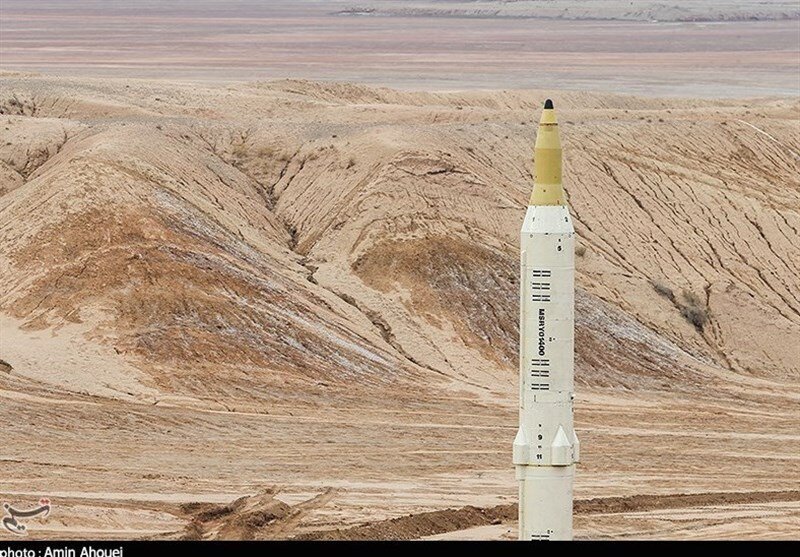
The Sejeel missile is one of the most important achievements of the defense industry of the Islamic Republic of Iran in the field of medium-range ballistic missiles. The main feature of this rocket is the use of solid fuel propellant in both flight stages; A feature that distinguishes it from many of Iran’s previous generation missiles. Possession of this technology, in addition to increasing mobility, also reduces the time of missile preparation for launch and plays an important role in improving the country’s deterrence power. According to Tasnim Mehrdad Akhli, Minister of Defense, he was one of the most influential figures in the construction and development of Sejeel project.
Sejil was known as “Ashura” in the early stages of development. On November 22, 2007, the first successful flight test of this missile was announced; At that time, the Minister of Defense announced that experts had achieved the technology of building a two-stage ballistic missile with solid fuel. Next, in May 2008, the test of the improved model of this missile named Sejeel was carried out.
The record of surface-to-surface missiles with a declared range of about 2,000 kilometers is in the category of medium-range ballistic missiles. The length of this missile is about 17.5 meters, the diameter of its body is about one meter and about 20 centimeters, and its weight when launched is about 23 tons. This missile uses two solid fuel propellant stages and can be launched using a mobile road launch platform. Its warhead is also separated from the main body, and the weight of the portable cargo is estimated to be around 650 to 700 kg.
The use of solid fuel is the most important technical difference between Sajil and missiles like Shahab 3. In liquid fuel rockets, the refueling process must be done before launch; But in solid fuel rockets, the propellant is already in the engine. This issue reduces the preparation time for the launch and makes it possible to move and deploy the missile in different positions. From this point of view, Sejeel should be considered as one of the important stages of Iran’s missile industry’s movement towards the development of mobile and quick standby systems.
When Sejil re-enters the Earth’s atmosphere and in the final stage of the flight, it has a speed of about Mach 11 to 13, approximately equivalent to 3600 to 4300 meters per second; Of course, these figures are related to the final stage of the flight and should not be equated with the speed of the rocket in all stages of movement.
It has been reported that the accuracy of Sajil hit is less than 10 meters, and this is due to the improvement of the guidance system and the use of more advanced navigation equipment.
According to Tasnim, tracking this missile is very difficult; According to this news agency, “the three-cone design of the Sajil missile’s warhead has reduced the radar cross section, and along with its supersonic speed, it makes it very difficult to intercept this missile in the final phase.” He also wrote about the reason for not intercepting this missile: “Sajil missile guidance system is a combination of GPS and INS, and this makes the missile resistant to electronic warfare and interference in positioning system signals. For this reason, the error of hitting this missile is estimated to be less than 10 meters, which is almost zero in a missile like Sajil.
In the continuation of the development of this missile family, Sajil was introduced with changes and improvements in the guidance and navigation system. The experiments of this family continued in the following years, and in the exercise of the Prophet of the 15th Corps in January 2019, the images of the missile launch were published again.
All in all, the importance of Sajil cannot be summed up only in its two thousand kilometer range. Achieving the technology of making a two-stage ballistic missile with solid fuel, reducing the preparation time and having a mobile launch platform has made this missile one of the examples of the progress of Iran’s defense industry. Sajil, along with other ballistic missiles of the country, is part of the set of capabilities that the Islamic Republic of Iran has developed to strengthen its defense power and maintain deterrence against foreign threats.
2929