



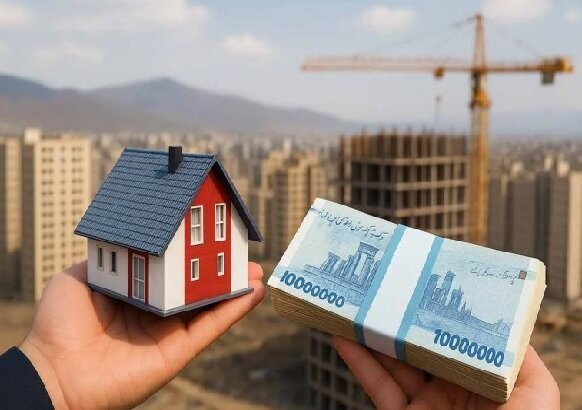



Young Journalists Club wrote: The housing market has faced a series of structural and economic challenges in recent years; From the increase in construction costs and the decrease in investment to the limitation of bank facilities and the backwardness of the purchasing power of households due to the growth of prices. The result of these conditions is a market that, although still facing a significant demand for shelter, a large part of the applicants do not have the possibility to convert this demand into a real deal.
In such a situation, the investigation of the housing market situation shows that the problem of this sector today is not only the number of built units or the amount of land at the disposal of the government, but the gap between housing prices and the financial power of households has become one of the most important obstacles for people to access their homes.
The increase in prices and the withdrawal of first-time buyers from the market
Daoud Biginejad, the first vice president of Tehran Real Estate Consultants Union, referring to the changes in housing prices compared to last year, believes that the purchasing power of applicants has not grown in proportion to the increase in prices.
According to him, in the point-by-point comparison of the market, a significant difference in the level of prices is observed; So that at one point the average price of each square meter of housing in Tehran was announced as 80 million tomans, but today, those who refer to the offices of real estate consultants in different areas of the city feel a significant increase in prices compared to last year.
Referring to the decrease in the number of housing purchase and sale contracts, Beginejad said: transactions in this sector have decreased drastically, and even in the rental market, the increase in prices in the summer season has forced some tenants to change their residential area.
He also raised the question whether the decrease in transactions is due to the lack of sellers or the decrease in the purchasing power of the applicants, and emphasized that the increase in prices did not match the growth of the buyers’ financial power.
On the other hand, according to the first vice president of the Tehran Real Estate Consultants Association, after selling one or two initial units and meeting the financial needs of the project, some of the builders do not have much desire to supply their other units; An issue that, in addition to reducing people’s purchasing power, has also aggravated the limitation of the supply of apartments.
This situation has made it difficult for first home applicants who rely only on cash savings or bank facilities to find a unit suitable for their financial capacity. In fact, a significant part of the available transactions is for people who already own a property and by selling it, they can buy a new unit or increase the size of their house.
lack of affordable housing; A problem beyond the number of available units
In the same context, Habibullah Taherkhani, Deputy Minister of Housing and Construction, Roads and Urban Development, emphasizing that the country’s housing stock is not out of balance with the number of households, believes that the main problem of the market is the lack of units that match the economic power of households.
Pointing out that housing is considered one of the most complex economic and social sectors of the country, he stated: Even in economies based on the free market, due to the failure of the market, the government must intervene to provide housing and provide people with access to suitable shelter; Especially in crisis situations where the implementation of real estate and rental support plans becomes more necessary.
Taherkhani continued to mention the statistics of issuing building permits in Tehran and said that at some points, around 200,000 to 220,000 building permits were issued for residential units, but in the census of 2015, more than 400,000 empty residential units were identified in the country, and a significant part of them were located in privileged areas.
Reducing investment and increasing construction costs
Referring to the performance of the construction sector, the Deputy Minister of Roads and Urban Development has announced that this sector managed to record a positive growth of 1.4% last year despite the country’s economic conditions, but this year the continuation of economic uncertainties and investment conditions has increased the hesitation of economic activists to enter this sector.
According to Taherkhani, more than 90% of the production and supply of housing in the country is done by the private sector, and for this reason, removing obstacles to production and facilitating the activity of builders is one of the priorities of the Ministry of Roads and Urban Development.
In such a situation, the builders are faced with two problems at the same time; On the one hand, the cost of housing production has increased, and on the other hand, the purchasing power of consumers has limited the possibility of selling units quickly at the prices expected by the builders.
This gap can lead to a reduction in new investment and a slowdown in supply; An issue that will affect the market balance in the long run.
Failure of banks to comply with legal obligations; One of the obstacles to housing production
Along with construction costs, financing is one of the most important problems in this sector; A subject that Abbas Sufi, a member of the Parliament’s Construction Commission, also emphasizes.
Criticizing the lack of proper implementation of housing laws, he said: If the approved laws were implemented correctly, we would not be facing many of the current problems today. The issue of housing is not limited to the assignment of land by the Ministry of Roads and Urban Development, and banks, the Ministry of Economy, the Central Bank and the institutions responsible for providing infrastructure also have duties in this field.
Referring to the review of the performance of the banks in the construction commission of the Majlis, Sufi said: In the reviews conducted online, it was found that the banks did not fulfill their legal obligations in the field of paying housing facilities, and for this reason, the delinquent banks were introduced to the judicial system according to Article 234 of the internal regulations of the Majlis.
He also emphasized that the Ministry of Energy and the Ministry of Petroleum also have obligations in the field of providing infrastructure such as water, electricity and gas for housing projects, which are necessary to complete the units.
These statements, along with the Deputy Minister of Roads and Urban Development’s emphasis on the difficulty of builders accessing bank resources, show that the housing financing system is facing challenges on both the supply and demand sides; On the one hand, the builders are facing restrictions to provide capital and complete the projects, and on the other hand, the existing facilities are not capable enough to help the buyers to enter the market.
mortgage; Covering only 10 to 15 percent of the house price
One of the most important signs of the decrease in the purchasing power of households is the limited share of bank facilities in the total price of housing.
Referring to the state of housing facilities, Taherkhani has stated that currently mortgages cover only about 10-15% of the price of an affordable housing unit; A figure that is not enough for average households to enter the market.
By comparing the situation of facilities in Iran and some other countries, he said that in many countries, housing facilities can cover up to 80% of the price of a residential unit, but in Iran, households find it difficult to enter the buying market even with savings.
At the same time, Abbas Sufi has also pointed out the change in the distance between facilities and housing prices by comparing the current conditions and previous years.
According to him, at one point, the facility of 350 million Tomans was paid in a situation where the price of each square meter of the apartment was about 2,500,000 Tomans, and as a result, the price of a 100-meter unit was about 250 million Tomans. Therefore, the applicant could hope to buy housing by using bank facilities.
But today, the price of a 100-meter residential unit has reached several billion Tomans, and bank facilities no longer play a decisive role in financing the purchase cost.
This comparison clearly shows that the nominal increase in loans, regardless of the growth of housing prices and household income, does not necessarily mean strengthening the purchasing power. In fact, when housing prices increase faster than the amount of facilities and household income, the effectiveness of bank loans in providing shelter decreases.
Delivery of 130 thousand support units
In the supportive housing sector, the government has plans to complete half-finished projects and deliver units to applicants.
Referring to the government’s commitments in the form of the national action plan and the national housing movement, Taherkhani has announced that around 850,000 units have been pledged by the government since 2018 and about 120,000 units of these plans have been delivered, of which 100,000 units were related to the performance of the 14th government.
According to the Deputy Minister of Roads and Urban Development, it is planned to deliver around 130,000 supportive housing units to applicants by the end of 1405. Also, more than 85% of these units have physical progress and their completion process is monitored weekly.
In this context, Taherkhani has announced considering the loan facility of 400 million tomans for qualified applicants in the lower income deciles and has announced that 200 million tomans will be allocated from the National Housing Fund for projects that have more than 80% physical progress.
Also, according to him, 8 thousand billion tomans have been considered to help the poor in housing this year, and the ceiling for housing facilities has also increased from 650 million to 850 million tomans.
The results of the statements of the officials of the Ministry of Roads and Urban Development, MPs and housing market activists show that the problems of this sector cannot be solved simply by increasing the number of built units or handing over land.
On the one hand, the Deputy Minister of Roads and Urban Development emphasizes the lack of dissatisfaction in the number of residential units compared to households and the lack of affordable housing; On the other hand, market activists talk about the limitation of the supply of sales files, the reduction of transactions and the exit of first-time buyers from the market. At the same time, parliamentarians consider non-implementation of bank obligations and delay in providing infrastructure as obstacles to the realization of housing programs.
In general, the housing market is facing a problem beyond the physical shortage of residential units. The existence of vacant units in privileged areas, the supply of expensive and large units, the decrease in the purchasing power of households, the limitation of bank facilities and the decrease of investors’ desire for construction, all show that there is a gap between the type of housing supply and the real needs of society.
Therefore, policy making in this sector should move away from focusing only on construction statistics and move towards the production of housing according to household income.
223225




