





According to Khabar Online, the late release of October inflation statistics by the Central Bank has once again brought to attention the alarming situation of macroeconomic indicators. In a situation where the monetary policy maker talks about reducing inflation point by point, the simultaneous examination of the three main inflation indicators presents a different picture. Monthly inflation has reached 6.4% after three consecutive months of increase, and annual inflation has reached record low levels by registering 4.71%. This is while the analysis of the one-year trend of the indicators shows that not all the inflationary pressures can be attributed to the war and the economic blockade, and the economic policies Currency shocks and energy price increases have also made an important contribution to the formation of the current situation.
Economic policy is the main cause of price jumps
After a long delay, the central bank finally published its calculations of the inflation rate until the end of October. This statistic was published on November 19; While the Central Bank and the Statistics Center of Iran published the previous month’s inflation report mostly in the first week of each month.
The Central Bank’s October inflation report, of course, is not as detailed as in previous months, and the monetary policy maker has limited himself to announcing three monthly, point-to-point and annual inflation rates and has refused to publish more details. Previously, the Central Bank published tables and charts at the same time as announcing the inflation rate. In simpler words, the October inflation report is summarized in two paragraphs this time.
The monetary policy maker announced the monthly inflation rate of 6.4% in October and calculated the point-to-point and annual inflation rate as 83.5% and 71.4%, respectively. These figures indicate a decrease of 0.3 percentage point point-to-point inflation compared to September and an increase of three percentage points in annual inflation during one month. The monthly inflation rate of 6.4% is the highest monthly inflation rate in the country since June.
Despite this, contrary to the central bank’s idea that the inflation rate will fall, a general look at the published statistics and the comparison of the inflation figures for October with previous months shows that it is still not possible to talk about such a trend with certainty. The slight decline in point-to-point inflation, as we have seen in the past two months, may continue; But the annual inflation will increase at least until January, and probably after that, part of the shock caused by the removal of the preferred currency will be discharged.
In the meantime, it is heard that the central bank and the government have recently decided to provide the required currency for almost all imported goods at the market rate. This decision will mean an increase of about 100,000 tomans in the import exchange rate, which will undoubtedly show its effects in the coming months in the form of an increase in inflation, both in the point-to-point index and in the monthly and annual indices.
monthly inflation fluctuation; The return of the rising trend
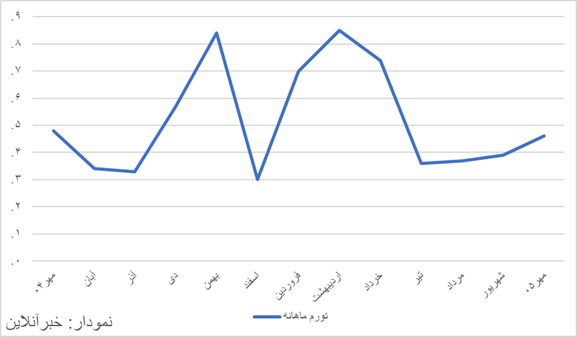
In the past year, the monthly inflation index has fluctuated a lot. During this period, the lowest monthly inflation rate was recorded in March and at the height of the 40-day war, with a figure of 3%. The highest monthly inflation was recorded in May and after the ceasefire, with a rate of 8.5%. Before that, the highest monthly inflation experienced in February and after the currency shock was 8.4%.
After May, a downward trend prevailed on the monthly inflation rate; In June, this index reached 4.7 percent, and in July and August, the figures were recorded at 6.3 and 7.3 percent, respectively. In September, the monthly inflation increased to 3.9%, and in the first month of autumn, the inflation rate was announced at 4.6%.
Therefore, even though the monthly inflation rate is still far from its peak, its trend has been increasing in the last three months and the acceleration of this increase has increased in October.
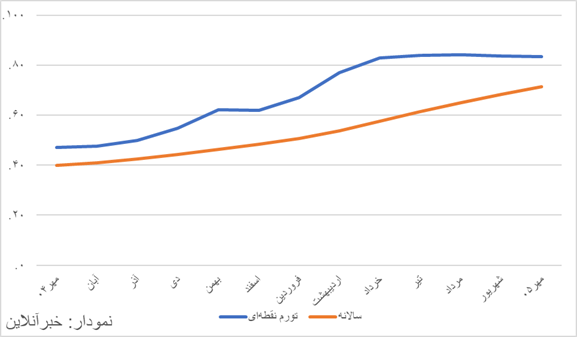
Point-to-point inflation has also increased significantly over the past year. This index was equal to 1.47% in October 1404 and reached 83.5% in October this year. In this way, during 12 months, the point-to-point inflation rate has increased by 4.36 percentage points.
The peak of point-to-point inflation in this period was recorded in August with a rate of 4.84%, and after that, a downward trend prevailed on this index. In September, point-to-point inflation decreased by 0.6 percentage points to 83.8%, and in October it decreased by another 0.3 percentage points.
During the last 12 months, the highest point-to-point inflation rate increase was recorded in May. Spot inflation in May was reported as 77.2 percent, while this index was 10.2 percentage points lower in April. Also, in February 1404, the point-to-point inflation rate increased by about eight percentage points compared to January.
Another noteworthy point is that during this period, in addition to the two months of Shahrivar and Mehr, where the point-to-point inflation rate decreased compared to the previous month, this index had a downward trend in another month, which was March.
Although the government’s economic team tends to identify the war as the main cause of inflation, macro indicators show that inflation not only increased but also decreased at the height of the war, i.e. March. In March 1404, the point-to-point inflation rate decreased by 0.1 percentage points and reached 62.1%.
Annual inflation on the verge of setting a historic record
The annual inflation rate reaching 4.71% means that the country’s highest inflation record after the occupation of Iran by the Allies in the early 20s is on the verge of being broken. The annual inflation index is the only index that has had an almost continuous increase in the last year.
The characteristic of the annual inflation index is that it reacts to price jumps with a time interval, and the effects of inflationary policies remain in it for at least one year. For this reason, even if the intensity of price shocks decreases in the coming months, their effect will still be reflected in the annual inflation rate.
In October 1404, the central bank had announced the annual inflation rate of 40% and during this one year, 31.4 percentage points have been added to this index. Before this year, the highest annual inflation recorded after the revolution was recorded in 1401 with a rate of 53.1%. Before that, in 1374, the annual inflation had exceeded 49%, one of the highest inflation rates in the years after the revolution.
The important point is that in all three periods when the annual inflation rate approached historical records or exceeded previous records, the economic policies of the government and in particular Shock treatment policies have played an important role.
In 1374, the implementation of the largest structural adjustment program in a situation where the war had ended and there were no sanctions against Iran’s economy, increased inflation to the threshold of crossing 50%. It was only with the suspension of the structural adjustment program that the increasing trend of inflation was stopped.
In 1401, the government of Ebrahim Raisi provided the basis for price jumps by implementing the policy of eliminating the preferential currency of 4,200 tomans. The recent inflation is also influenced by price shocks in the currency and energy market, rather than just being affected by war or economic blockade.
The sum of these developments shows that although the war and economic restrictions have put additional pressure on Iran’s economy, the role of economic policies and government decisions in creating and intensifying inflationary shocks cannot be ignored. The trend of inflation indicators also shows that the limited drop in point-by-point inflation alone is not a sign of curbing inflation, and Iran’s economy is still facing the increasing pressure of price increases.
223229




