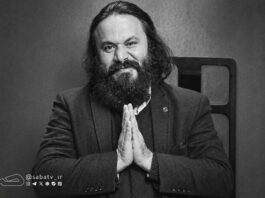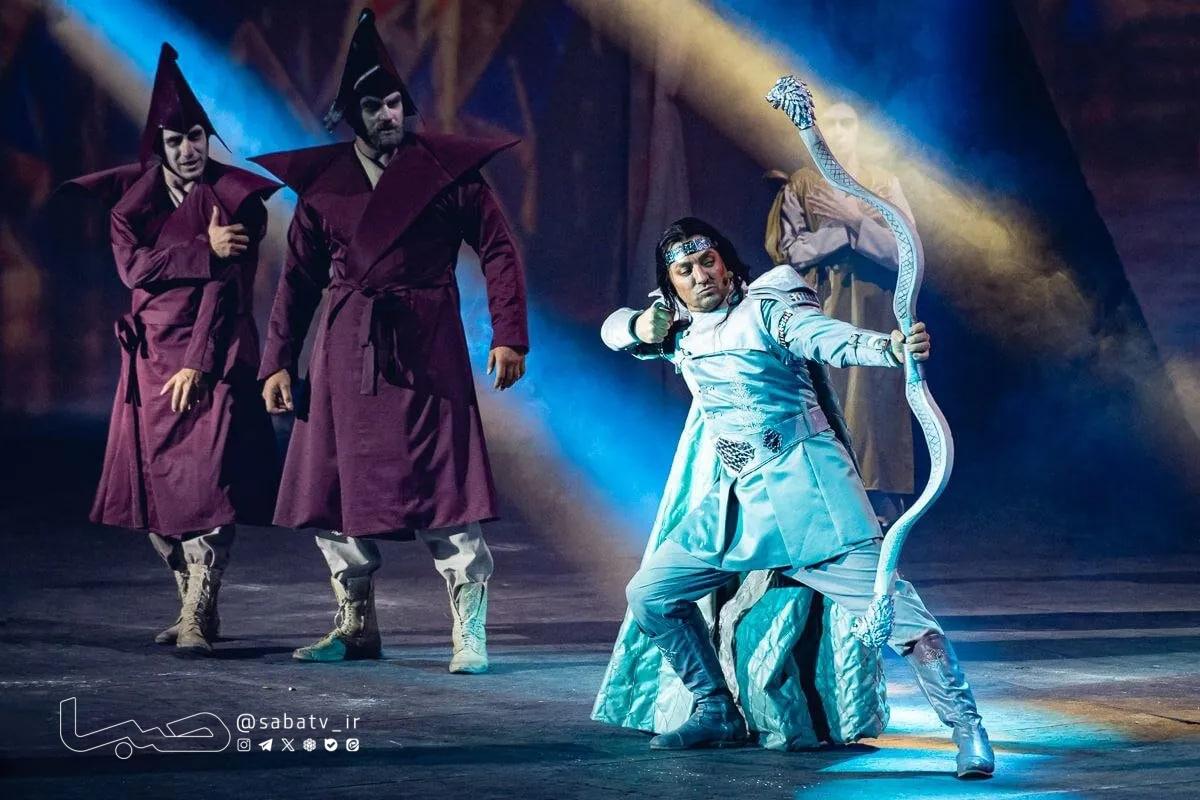
Servin Dehghan/Saba, Hossein Parsai, after experiencing the performance of “Heft Khan Esfandiar” and “Battle of Rostam and Sohrab”, this time with the concert show “Siyavsh” he went to one of the most tragic narratives of Ferdowsi’s Shahnameh. A narrative about purity, agreement and the ideal of peace, which leads to disaster when dealing with power relations and politics. In this work, in addition to directing, Parsaei has also been in charge of the dramaturgy of the text of Matin Ezadi’s play and has tried to put Siavash’s character in a humane and tangible position for today’s audience by going beyond the mere representation of a mythological narrative. This work will be staged on the 6th, 7th and 8th of November. In an interview with Saba, Parsai talked about his view of the legend of Siavash, the relation of this narrative to the contemporary world, the challenges of adapting the Shahnameh, the selection of actors, the role of music and stage design, as well as the difficulties of producing a great work in the private sector.
Siavash; A hero who refuses to continue the war
Parsai considers “Siavash” to be the most different point in the tripartite path that he started with his two previous experiences in re-reading the Shahnameh. According to him, “Heft Khan Esfandiar”, “Nabard Rostam and Sohrab” and “Siavash” together talk about the human crisis in the face of power, duty and destiny; with the difference that Siavash is the most knowledgeable and moral character in this series. He knows his destiny, but he is not willing to give in to Peleshti to get rid of it.
From the director’s point of view, what distinguishes Siavash’s story from many epic narratives of the Shahnameh is its anti-war and pacifist aspect. Siavash is not a prince who is deprived of the ability to fight; He was brought up by Rostam in Zabul and learned the art of war and battle, but when he was faced with the surrender of Gersivuz and Afrasiab on the border of Iran and Turan and the formation of a peace treaty, he was not willing to obey Kikavus’ order to break the treaty and kill the prisoners.
Parsai believes that the importance of this decision lies in the fact that Siavash, despite having military power and might, prefers ethics over political orders. He considers breaking a treaty against the custom of freedmen and is not willing to violate his principles in order to please the king. From this point of view, the director introduces this character as a symbol of moral choice against power relations and says: “Sivash is an epic of moral choice against the quagmire of politics and power-seeking.”
This reading for piety is not limited to the world of mythology. He believes that Siavash’s narrative can be a mirror for contemporary man in a situation where parts of the world and the Middle East are involved in war, suspicion and political deception. A person who sometimes has to pay a heavy price for sticking to his truth and conscience. According to him, Siavash became a victim of the totalitarianism of the two courts of Iran and Turan, and his fate shows that even being away from the battlefield does not necessarily free a person from hatred, conspiracy and violent relations of power.
Parsaei also considers Siavash’s passing through the fire to be more than a mythical and amazing event and describes it as a model for measuring human conscience and purity. In this view, crossing the fire is not only a show of bravery, but it is a human’s encounter with the truth of his existence. At the same time, he emphasizes that Siavash’s story does not end with death and oppression; Because in Iranian culture, Siavash’s mourning and Siavashan’s religion are linked with seeking justice and hope for the future. Therefore, Siavash’s blood in the mythological narrative can be a sign of birth and awareness.
distance from sanctification; Siavoshi with human fear and loneliness
One of the main challenges of adapting the Shahnameh, in terms of piety, is preserving Ferdowsi’s spirit and thought along with finding a language suitable for today’s theater. He believes that the Shahnameh is so rooted in the collective and unconscious memory of Iranians that any clumsy manipulation of it will be met with resistance from the audience. However, simply retelling Ferdowsi’s narrative is not enough to turn it into a dramatic work.
Parsai considers the greatest danger in retelling Siavash’s story to be caught in the trap of absolute sainthood. According to him, if Siavash becomes a superhuman character who has no fear or doubt and moves towards his destiny without internal conflict, the possibility of the audience’s identification with him will decrease. Therefore, the production group has tried to put Siavash in difficult situations and show his emotional and psychological dimensions.
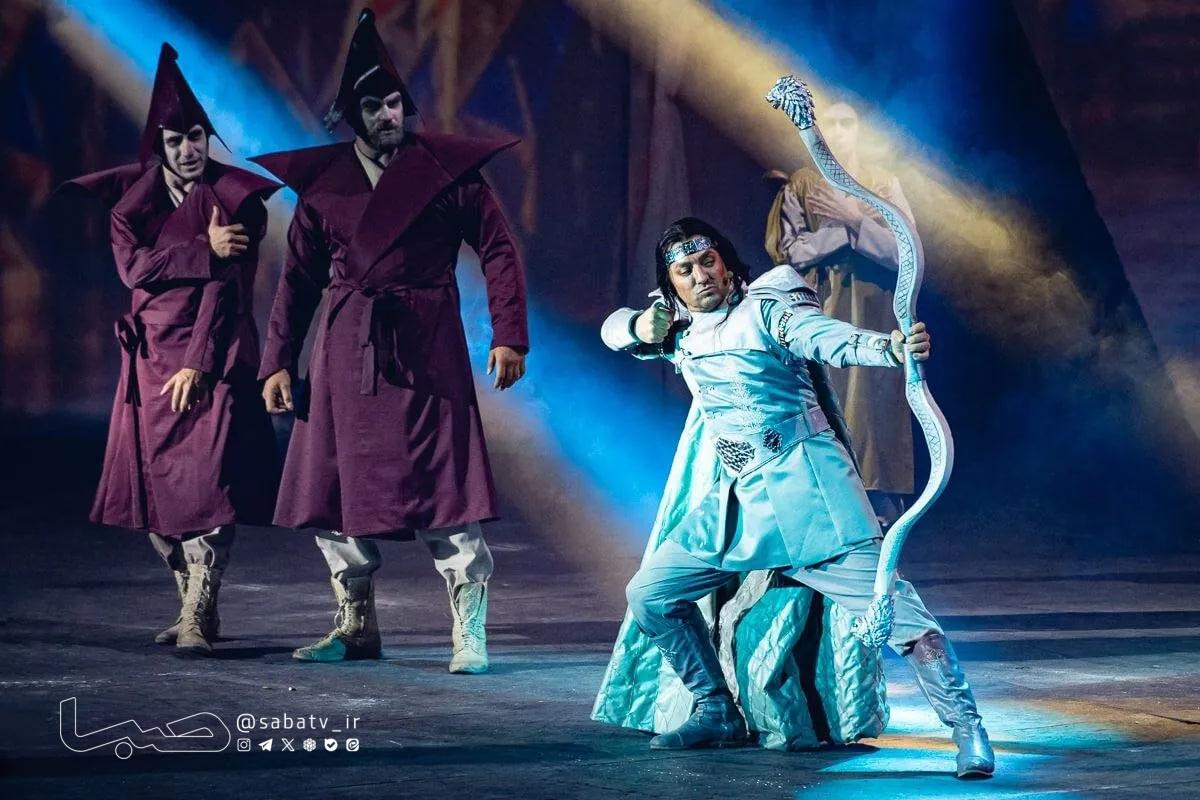
In this retelling, Siavash is not the only victim of Sudabah’s lust in the court of Kikavus; He is an emotionally helpless prince. He does not have a mother to shelter him, he is faced with a shaky and gullible father, and he is faced with a stepmother who wants to possess him. For this reason, passing through the fire for Siavash is not just a test to prove purity, but an attempt to get rid of the corrupt atmosphere of the court; An attempt that comes with the risk of death.
The director has also distanced himself from the one-dimensional view in the characterization of other characters in the story. Sudaba is not the only evil and seductive woman in this narrative; He lives in a golden cage next to an old and autocratic king, and in Siavash he sees youth, beauty and purity that he has not experienced in his own world. In this way, the desire, madness of possession and suffering caused by neglect are mixed in his behavior, and Siavash’s situation when he rejects his request acquires more dramatic dimensions.
In Parsai’s view, Afrasiab is not just an evil character, but a veteran politician who is caught between paternal love for Siavash and the fear of losing the throne. The provocation of those around him and his suspicions eventually lead to disaster. On the other hand, Siavashgerd, the city that Siavash builds for a life free from war, reflects his dream of building a world based on peace and tranquility; A dream that is not safe from the sting of jealousy and conspiracy even after moving away from the Iranian court.
Bahram Radan; A choice beyond fame and box office
The choice of actors in a large production is always accompanied by the question of the ratio of artistic ability and the ability to attract the audience. Parsaei also considers this issue as one of the serious challenges of directing such a project, but emphasizes that choosing Bahram Radan to play the role of Siavash was not just an economic decision or aimed at the box office.
According to him, Siavash is the most beautiful and noble Iranian prince in Shahnameh; A character who must convey to the audience both Rostam’s cultivated strength and the innocence and purity of his face. Parsaei believes that Bahram Radan has characteristics that can reflect the legendary dignity of this character on the stage in terms of physique, emotion, look and dignity. He also considers Radan’s experience and maturity after years of working in cinema and theater to match Siavash’s psychology in this performance.
However, the director does not deny the role of fame and popularity of artists in introducing a great work and attracting a general audience. According to him, in a project that faces several thousand spectators every night, the influence of well-known faces cannot be ignored; But fame alone does not guarantee success on stage. He emphasizes that an actor who cannot bear the weight of the role, even with fame and many followers, cannot be successful in front of thousands of viewers.
Parsai also considers the border between the dramatic use of the actor’s charisma and celebrityization to be important regarding the criticisms that are sometimes made about the presence of movie and television stars in the theater. In his opinion, when the fame of the actor becomes independent from the logic of the work, the spirit of the show and the dignity of the theater will be the first victims of this situation. For this reason, he tried to use the experience and popularity of the actors to serve the text, the rhythm of the scene, the movement, the evolution of the characters and the world of the drama. He reminds that the well-known actors of “Sivash” have also entered the project with professional background and theatrical experience and have participated in intensive and several months of training.

Ali Zandukili; A voice between epic and mourning
Music in “Sivash” is not only an element along with the image and movement, but also a part of the dramatic structure of the work. Parsai considers the choice of Ali Zandukili to be the result of his previous collaboration experience in “Battle of Rostam and Sohrab”, the quality of his voice, and the need of this show for a narrator with epic and tragic capacity.
He says that in the previous collaboration, he realized that Zandukili is not just a singer with a good voice; Rather, he knows theater and acting, has experience of being on stage and is familiar with silence, suspense and roar in live performances. Therefore, from the early stages of the formation of the “Sivash” project, his voice has been considered to narrate this story.
According to Parsai, the story of Siavash has two main aspects: epic and mourning, and it needs a voice that can communicate between the strength of the epic narrative and the burning of ancient Iranian hair. In his opinion, the reverberation of Zandukili’s voice is reminiscent of Iranian naqali and at the same time close to instrumental and official music. His ability to perform passionate elegies is also important for moments like Siavash passing through the fire and being killed.
In this project, in addition to playing the role of narrator, Zandukili is also in charge of the music group. Parsai emphasizes that this decision was made with the aim of linking the music to the text and the mise-en-scènes; In such a way that the music is formed from within the dramatic action and is not placed just as a sound accompaniment next to the performance. Soroush Mohammadi as the composer, Parsa Asadi and Mehrdad Azimi in the music group, Ali Safari in songwriting, Mohammad Zandukili in composing the melody, and Mojtabi Abolqassimpour in arranging are among the other collaborators of this department. According to the director, Zandukili has been present in the rehearsal hall since the early stage of etudes, and music has gradually become one of the main pillars of the narrative.
Eight months of training and preparation for a big performance
Parsaei says about the preparation time of “Siavash”, if the ideation sessions until the public performance are considered, this project has taken more than a year and a half of the group’s life. However, from the beginning of the field exercises to the night of the public performance, about eight months of intensive training and preparation have taken place.
This time was not only devoted to the actors’ training, and the coordination of music, special visual effects, moving sets, sound, light effects and field performance difficulties were also part of the production process. Parsai believes that in the private sector, the unreasonable prolongation of rehearsals and preparations can put the project at risk of bankruptcy before reaching the stage. He considers what was performed on the stage to be the result of hundreds of hours of collective effort, discipline and dedication of a group that had no place for negligence and trial and error during public performance to perform a work of epic proportions.
In the same context, the director of “Siavash” appreciated the investors and producers of the work, Seyed Mahmoud Shabiri and Jalil Kia, and considered their participation effective in accepting the financial risk of such a project.
stage design; Part of the dramatic language of the work
In Parsai’s view, the stage design and large mezzanines in “Siavash” are not merely decorative, but are part of the language of the drama and reflect the work’s worldview. He believes that in the world of Shahnameh, geography is not the only place where events take place and can be the embodiment of a kind of worldview. From this point of view, the performance spaces should be designed in such a way to convey to the audience the weight of power relations and the fragile position of the characters in front of it.
He considers the visual contrast between the darkness of Kikavus and Afrasiab and the brightness of the ideal city of Siavashgerd as one of the important elements of stage design. According to Parsaei, this contrast required multi-modal lighting, architectural volume and precise depth of field design. The scene of crossing the fire is also an example of this approach; Because in his opinion, if this moment was only represented by changing the color of the light, an important part of its sense of danger, terror and wonder would be lost.
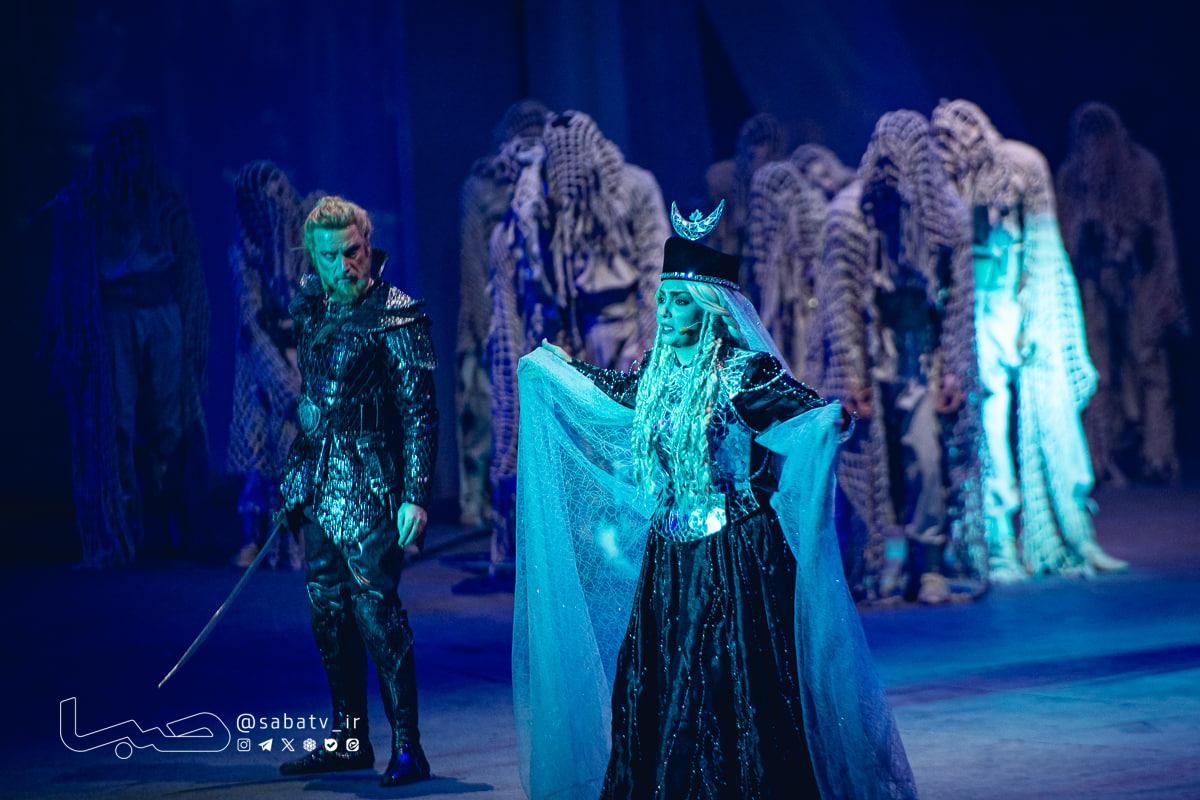
Referring to his experience of working in small and minimal spaces, Parsai emphasizes that he believes in the capacities of minimal theater and black box to express individual crises and psychological dramas; But he believes that the Shahnameh, as a national epic, needs appropriate executive language to convey the dimensions of its world. Therefore, large movement groups, multi-person battles, deep projections and reverberating percussion instruments are used in this performance to engage the audience in a collective emotional experience. His goal has been that Ferdowsi’s words can maintain their awe and influence in today’s scene as well.
Ticket prices and the difficulty of public access to the theater
One of the other parts of the conversation is dedicated to the price of the ticket and the possibility of families to watch the big plays. Parsai considers this to be one of the most bitter questions that can be asked of the director of a big project. He says that when a middle-class family of four has to give up a significant portion of their monthly income to buy tickets, travel and incidentals to see a show, it’s impossible to be indifferent to this fact.
However, he differentiates between the responsibility of the artist and the economic conditions of the production and believes that the production team has done their best to manage the costs and the producers have been as fair as possible in determining the ticket price. According to Parsaei, the private sector, in a situation where it does not have public subsidies or effective support, is forced to cover most of the production costs from the ticket sales point. In such a situation, lowering the ticket price from a certain level can make the project face the risk of bankruptcy.
Referring to government support, subsidies and tax exemptions in some countries for large theaters, classical works and operas, he emphasizes that public access to theater cannot be achieved only by the individual responsibility of artists and producers and needs more effective support mechanisms; Mechanisms that prevent the transfer of all heavy production costs to the audience.
Parsai’s emphasis on the privacy of the financial resources of “Sivash”
In the final part of the interview, Parsai has responded to the claims made about the project’s financial relationship with the Ouj Media Art Organization. Referring to the previous denial of the show’s public relations, he emphasizes once again that “Siavash” is a completely private project and its costs have been financed from the personal capital of Seyed Mahmoud Shabiri and Jalil Kia. Parsai says that this work has not received any amount from the Ouj organization or any governing, security, government or organizational institution. He also points to the existence of financial documents, contracts, tax offices and information registered in official ticket sales systems, and introduces these documents as reviewable./Saba Newspaper