



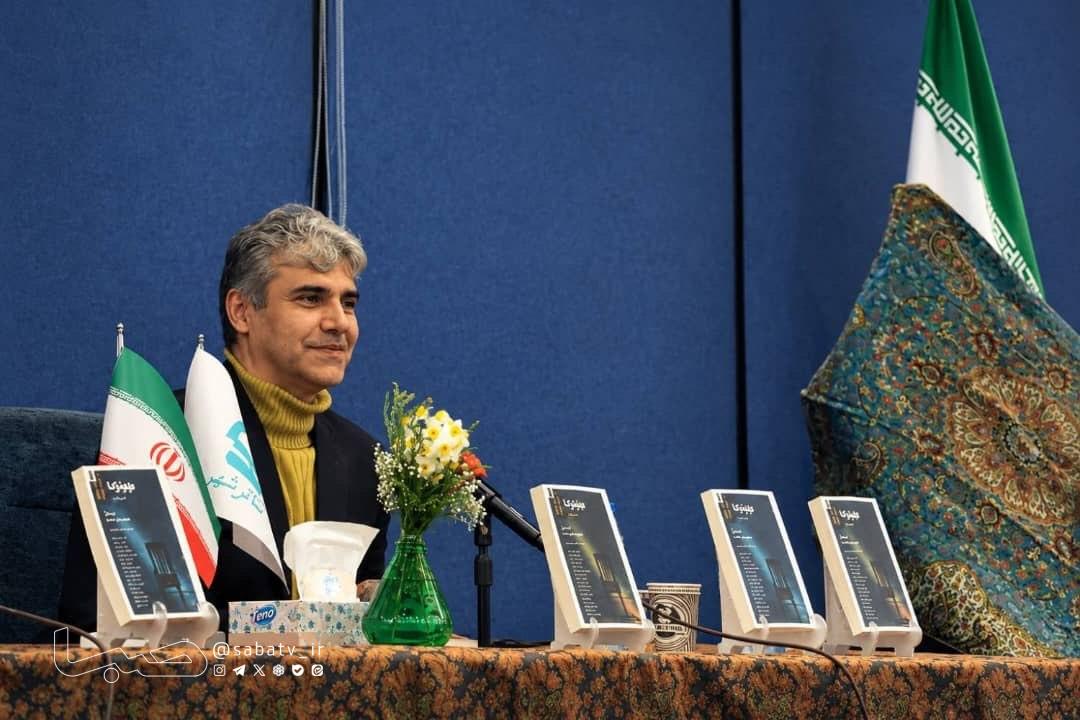


Saeed Ghasemi, Director of Gozen Sefid Publishing House, referring to the economic difficulties and the decrease in the desire of publishers to publish authored works, announced the call of “Hamdastan” with the aim of identifying and supporting the authors of short stories and emphasized: the publisher should not only look for return of investment, but should establish a relationship between the author, the work and the audience.
Nasser Arbab/Saba, At a time when economic problems, increasing production costs and worries about investment returns have pushed an important part of the publishing industry towards less risky choices and the publication of best-selling works, supporting new writers and authored literature has become one of the serious challenges of publishers. In such a situation, establishing a new publishing house and issuing a call to identify fiction writing talents can be an attempt to enter a different path; A path that, of course, also faces the difficulties of the publishing market. Saeed Ghasemi, author, translator and director of Gozen Sefid publishing house, has taken the first step of this series in the path of discovering and introducing story writers by publishing the call for “Hamadastan”. He believes that the shortness of a story does not mean its simplicity, and this literary format can provide the audience with a deep and thought-provoking experience in a limited volume. In the conversation with Ghasemi, Saba talked about the publishing situation, the challenges of new publishers, the need to support authored literature, and the goals of the “Hamadastan” call, in addition to the motivations for establishing these publications. Ghasemi, a doctoral student in the philosophy of art and dramatic literature, has several published plays in his repertoire, among which are “Embraced by a Snowman” in Afraz Publications; And he mentioned “Hate in the Airport”, “Ottawa”, “For Anna” and “Vladimir’s Lantern and Estragon’s Hat” published in Nizam al-Molk. He also translated works such as “Kloeka” published by Tareh and “Tabah” published by Manyahner among his other activities. Ghasemi recently established a publishing house called “White Deer” and published a call called “Hamadastan”. This event became an excuse to talk with him about his motives for entering the field of publishing, and the plans of “White Deer” publications.
What happened to Mr. Ghasemi to think of establishment? Did you fall for White Deer Publications?
My great interest in literature and art, and my belief in the humanizing art industry of book publishing, prompted me to increase my activity in this field. Regardless of the cultural and economic importance of book publishing, I myself am both a writer and a teacher; And from this point of view, I would like to provide an opportunity for writers and translators to publish their works and establish a cultural relationship with their audience. In my opinion, reading a book can have a great impact on human thought; change his outlook on life; and even change the course of his life. Perhaps it is the possibility of influencing people’s lives that makes working in the field of publishing important and meaningful for me. Because my life found a new direction by reading several amazing books.
which books
“The Brothers Karamazov” by Dostoyevsky and “The Lost Shepherd’s Lamb” by Houshang Golshiri. These books had a very important role and influence in my life.
How do you see the current situation of Iran’s publishing industry?
Like other publishers, I am worried about the condition of the paper and the unfavorable conditions of the book market; But I believe that we should continue and keep the light of books and reading on. Economic and cultural problems, no matter how serious they are, are not permanent. We can and should hope that the situation will improve in the future. I believe in the cultural and artistic capacities of society. Our people are very interested in art and literature; And this is part of the cultural capacity of our country. I think that if economic and social conditions improve, people will welcome books more than ever. For this reason, I think that despite all the shortcomings and difficulties, we should continue to strive for the continuation of publishing and maintaining the cultural connection of people with books. In recent years, we have published many authored works with the group of drama writers, which is managed by Bakhil Esmaili, according to the specialized cultural, artistic and literary needs of the society. This group worked with many publishers and the works reached the printing stage without any problems. But now the publishers’ concerns are different and the return of capital has pushed them to translate, print and publish the world’s best-selling novels.
What are the most important goals and cultural programs of “White Deer” publications?
We intend to work in the fields of theater, cinema, dramatic literature, philosophy and fiction. These areas have a large audience and establish an important link between the university, the artist and the audience of art. I mean the audience of art includes a wide range of people in society; Any person with any class, occupation and social position who is interested in art. Art has a wide audience. Therefore, we will be careful and obsessive in choosing the works and we will try to publish books that can help expand the knowledge and intellectual horizon of students, professors, artists and those interested in these fields. For us, the goal is not just to publish the book; Rather, we try that each of our works can add something to the knowledge and experience or way of looking at art audiences.
What do you think are the most important challenges for new publishers?
I think of three things; First, economic problems and return of investment, which is very difficult for a publisher that has not yet found its place in the market. And then gaining the trust of the audience and introducing suitable books to the readers also requires a lot of time and effort. But I think the more important challenge is to introduce valuable works and provide opportunities for writers who are not yet known. The publisher is not only responsible for printing books; Rather, he should be able to establish a proper relationship between the author, the work and the audience. This responsibility is especially important for a newly established publisher that wants to form its own cultural identity; And it will definitely not be easy. However, I believe that the existing difficulties should not deter or divert us from continuing the path. If we want the future of Iranian literature to be fruitful, we must work to publish valuable works and support young and talented writers. We may not be able to solve all publishing problems, but we can play our part in this direction by making the right choices and creating new and appropriate opportunities.
Tell us about the “Hame story” call. Why did you start with “story” or “microfiction”?
The call for “Hamadastan” was published by my colleague, Mr. Khalil Esmaili, to provide an opportunity for young and experienced writers to submit their short stories for publication to “Gozen Sefid Publications”. All the works will be judged and finally the selected works will be published in a collection of stories called Hamadastan. For the first step, we went to the story; Because we believe that the brevity of a work does not necessarily mean its simplicity. A short story, despite its small volume, can create a surprising and impressive encounter for the audience and convey a deep thought or concept to him in a few lines. Sometimes a short story, instead of explaining everything, engages the audience’s mind with a question that stays with them for a long time. We believe that the story can be a good start for our publishing activity; Because, on the one hand, it provides the possibility of the presence of writers with various knowledge and experiences; And on the other hand, it confronts the audience with a compact and at the same time thought-provoking form of the story. Of course, our hope goes beyond simply publishing a collection of stories. We would like White Deer Publishing to provide an opportunity to discover and introduce new talents. Perhaps among the writers who send their first works for this call and are supported today, there are those who will play an effective role in Iranian literature in the future. If we can even help a few talented writers enter and grow in the field of literature, I think this beginning has found its value.
And the last word?
Thank you for giving me this opportunity and I think today more than ever we need to maintain our connection with books and literature. A book is not just a means of transmitting information; It can change the way we look at ourselves, others and the world. As a writer, teacher and publisher, I would like to contribute to this. I know that activity in the field of publishing, especially in difficult economic conditions, faces many obstacles and problems; But I believe that under the excuse of these difficulties, we cannot stop trying to keep culture, art and literature alive. I hope our publication is an opportunity to publish valuable works and introduce new voices; Especially writers who may not have had enough opportunities to be seen and read yet. If one day a book published with our efforts can engage a reader’s mind, raise a new question in him or create a positive change, even if small, in his outlook on life, I feel that part of our publishing goals have been achieved. I believe that paying attention to the future of art and literature and providing opportunities for young writers is an undeniable necessity; Because neglecting new talents and ignoring the young generation of writers can make the country’s literature face more serious challenges in the future. I hope that the publication of the call for co-conspirators is a step towards identifying and supporting new talents, and contributing to the future of Iran’s culture, art, and literature.




