





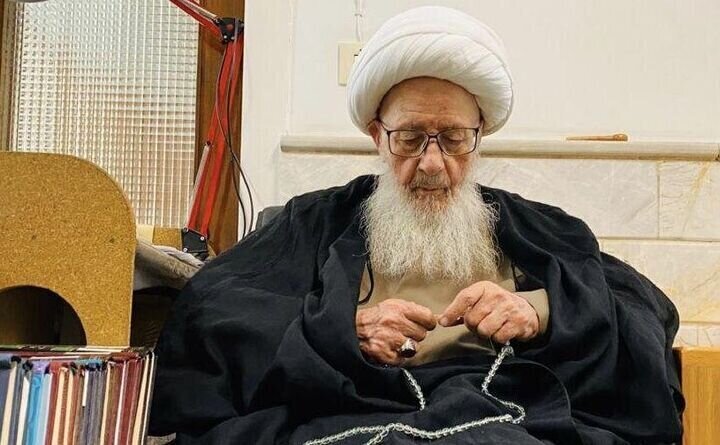
Online news: It has been a few days since the news of hospitalization Ayatollah Hossein Vahid Khorasani It has been published from the sources of Shiite imitation in the intensive care unit of the ICU of a hospital in Tehran; In the past few days, the news of the death of this imitation authority was published twice in some Telegram channels, which was denied by his office.
The characteristic and distinguishing feature of this taqlid authority in the field is the absence of political comments and non-interference in politics. However, his son-in-law, Sadegh Amoli Larijani, has caused him to be placed in the political atmosphere. However, he still avoids entering the field of politics. That is why he rarely meets political figures.
But one of the famous meetings of the Ayatollah is his meeting with Seyyed Mohammad Khatami during his presidency. Mohammad Ali Abtahi, the then head of the office of Mohammad Khatami during the presidency of 2013, narrated this meeting in a conversation with Shia News: “In the evening when we went to meet Ayatollah Vahid Khorasani, we (Mr. Khatami’s delegation) entered his outer room together and sat down. After the tea, Ayatollah Vahid told Mr. Khatami in the same sweet and considerate tone that I have something to do with you in this room, they took Mr. Khatami’s hand and got up. We looked at each other and they left with a smile. After about half an hour, they came out with a broken face. Both eyes were red. It was clear that they were crying. The atmosphere was heavy and silent…we all got up and said goodbye and left. After the meeting, I asked Mr. Khatami about the content of the meeting. As far as I can remember, he said: Ayatollah Vahid Manqalb was upset and told me that since the beginning of the revolution, I have suggested to all the officials that they should have the honor of celebrating the martyrdom day of Sediqa Kobari. This honor has not been given to anyone and none of them have taken it seriously. But this honor will be yours. Then they talked about Zahra Marzieh’s virtues and virtues [ اینجا هر دو به گریه افتاده بودند] Mr. Khatami could not stop his tears. After explaining the story, Mr. Khatami told me: I promised Ayatollah Vahid that I would close the martyrdom of Hazrat Zahra (PBUH). Check the legal ways.” And of course that happened and the martyrdom anniversary of Hazrat Zahra (PBUH) became an official holiday in Khatami’s government.
The beginning of the lesson and discussion
Grand Ayatollah Vahid Khorasani was born in Neyshabur in 1300. He started his religious studies in Mashhad; A city that at that time was one of the important religious science education centers and the place where prominent professors of the field attended. After learning the basics and Arabic literature, he entered the higher stages of the field to continue his studies and learned the level courses from Ayatollah Sheikh Mohammad Nahavandi, one of the well-known masters of that era.
After finishing the level course, Ayatollah Vahid Khorasani entered the foreign jurisprudence course; A stage that in the educational system of the field, brings the student closer from the teaching of textbooks to the independent investigation and inference of jurisprudential issues. During this period, he benefited from the classes of Ayatollah Mirza Mehdi Isfahani and Ayatollah Mirza Mehdi Ashtiani. In addition to jurisprudence and principles, he also studied intellectual sciences and philosophy with professors such as Mirza Abulqasem Elahi and Mirza Mehdi Ashtiani.
One of the important points in his scientific path was receiving permission for ijtihad from Ayatollah Seyyed Mohammad Hojjat Koh Kamrehai in 1327. This permission was issued after a scientific discussion and discussion between the two of them, and it indicated that Ayatollah Vahid Khorasani had reached a stage of scientific ability that provided him with the possibility of inferring Sharia rulings.
Twelve years of studying under Ayatollah Khoei
At the age of 27, Ayatollah Wahid Khorasani went to Iraq to complete his education and get acquainted with the scientific views of the teachers of Najaf, even though he had reached the rank of ijtihad before leaving for Najaf. His presence in Najaf should be considered one of the most important steps in the formation of his scientific personality.
In this city, he participated in the lessons of teachers such as Ayatollah Seyed Abdolhadi Shirazi and Ayatollah Seyed Mohsen Hakim, but the most important person who played a role in his scientific path was Ayatollah Seyed Bolqasem Khoei. Ayatollah Vahid Khorasani attended Ayatollah Khoei’s Islamic jurisprudence and principles course for many years and became closely acquainted with his way of reasoning and scientific method.
In that period, the Najaf area was one of the main centers of jurisprudential and fundamental sciences in the Shia world, and attending the lectures of eminent authorities provided students with an opportunity to learn the scientific basics and learn different methods of inference and ijtihad. Ayatollah Vahid Khorasani, after many years of studying in this area, turned to teaching seminary sciences and started teaching foreign jurisprudence and principles in Najaf.
He taught in Najaf for about 12 years; A course that, in addition to completing his scientific experience, provided the basis for the formation of his position as a professor in the field.
Returning to Iran and settling in Qom
Ayatollah Vahid Khorasani returned to Iran in 1349. He first went to Mashhad and taught in this city for about a year, but then he chose Qom for his residence and scientific activities. Moving to Qom was another turning point in his life, considering the position of Qom in the structure of Shia seminaries.
He continued to teach foreign jurisprudence and principles in Qom and gradually a circle of students and scholars formed around his teaching. In the educational system of the field, the external lesson is considered the highest level of specialized education in jurisprudence and principles, and instead of teaching a specific text, the professor discusses and argues the issues by proposing different points of view and examining evidence.
Ayatollah Vahid Khorasani’s lesson became one of the most prosperous meetings in the Qom area in the following years. Accuracy in fundamental topics and paying attention to the details of jurisprudential arguments are among the features mentioned in the description of his teaching method.
The death of Ayatollah Mohammad Ali Araki in 1373, once again brought up the issue of identifying and introducing imitation authorities in Qom seminary. At this point, the community of teachers of Qom seminary introduced the name of Ayatollah Vahid Khorasani along with a number of other prominent jurists as a reference for imitation.
In the following years, Ayatollah Vahid Khorasani focused his activities mainly on teaching, responding to Shariah issues and managing the collection related to authority. In addition to jurisprudence and principles, attention to the Quran, Hadith and the teachings of Ahl al-Bayt also had a significant place in his lectures and scientific activities.
Ayatollah Vahid Khorasani is one of the professors who spent an important part of his academic life in this structure and through the training of his students and his presence in the position of authority, he has been influential in the intellectual and religious atmosphere of the domain.
What distinguishes Ayatollah’s academic life is the continuation of a long path from studying in Mashhad and Najaf to teaching in Qom; The path that started from being a student with prominent Fiqh and Usul professors and reached a place where today his name is among the well-known and famous Shia authorities.
2929



