





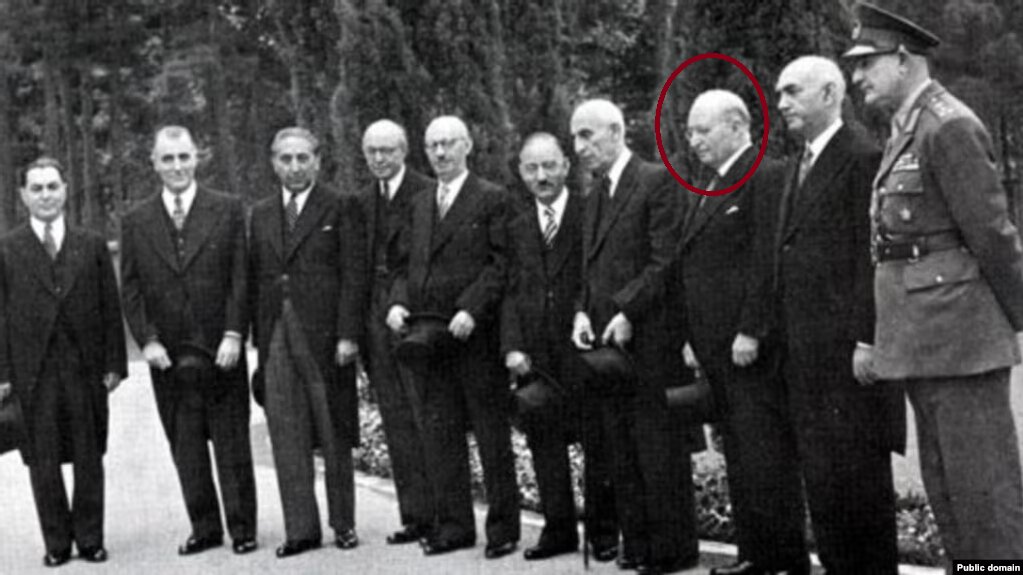
Mohammad SadeghiJournalist and history researcher: On the evening of 11 May 1330, Mossadegh met the members of his cabinet, namely Bagher Kazemi, Minister of Foreign Affairs, Fazlollah Zahedi, Minister of Interior, Ali Asghar Naqdi, Minister of War, Mohammad Ali Warasteh, Minister of Finance, Ali Hayate, Minister of Justice, Yousef Mashar, Minister of Posts, Telegraphs and Telephones, Javad Bushehri, Minister of Roads, Amirtimor Kalali, Minister of Labor, and Hasan Ali Farahmand Ziaul Malik, Minister of Agriculture, in the palace. Abiz introduced to Mohammad Reza Shah, and gradually employed other ministers as well. Baqir Kazemi, born in 1271 and died in 1355, is one of the prominent Iranian ministers and politicians who was first the foreign minister and then the finance minister in Mossadegh’s government. When Mossadegh decided to go to the United States to attend the Security Council, he introduced Kazemi to the Shah as prime minister in his absence on October 10, 1330, and to the National Council and the Senate in the following days, and he left for New York on October 14. When he left for The Hague, he appointed Kazemi as the prime minister’s guarantor.
As we read in the fifth volume of the book “Notes on the Life of Bagher Kazemi”, after whispers about the appointment of Ali Amini in the cabinet, Kazemi, who was skeptical of him, objected to Mossadegh, but Mosadegh comforted him a lot in the meeting, in such a way that both of them cried, but in the end, Amini joined the cabinet. Kazemi was the foreign minister in Mossadegh’s first government, after him Hossein Nawab (who was trained as a diplomat) took over this responsibility for a very short period of time, and then, Mossadegh placed Hossein Fatemi in this position. Also, due to Mossadegh’s physical condition, Kazemi was very diligent in managing government meetings and organizing official and private greetings and introducing official officials to the king, etc. during that period. Assigning the foreign ministry to Hossein Fatemi, who had no background or expertise in the field of diplomacy and foreign policy, is one of the issues in Mossadegh’s government, which Kazemi is also sensitive to. “Unfortunately, the election of Dr. Fatemi to the Ministry of Foreign Affairs and his being the spokesperson of the government caused the dissatisfaction of the representatives of the Senate and the Shura Assembly and the million, and his behavior with the members in the Ministry of Foreign Affairs was also very bad and he threatened them with exile to Khark, etc… Dr. Hossein Fatemi had a special manners and manners that made everyone dissatisfied with him, and he used to speak in the government spokesperson without consulting and agreeing with the government delegation, and his statements were harsh and inappropriate, and they are reflected in the Bakhtar newspaper today. It would be.”
Kazemi then served as the Minister of Finance, and of course, in his notes, he also wrote about a fierce argument between himself and Mossadegh, “I didn’t want to accept the Ministry of Finance that he insisted on, and he argued that your service in the Ministry of Foreign Affairs was very regular and you worked hard, but now the Ministry of Foreign Affairs is no longer the first priority, and the Ministry of Finance is the most important task, and with this economic and political situation, its administration is of the utmost importance. and I either have to deal with it personally, and this is impossible with the Ministry of War and my temperament and physical state, or someone like you should take it on, and if you don’t accept, I won’t be able to form the cabinet at all, and he promised me to give him a definitive answer by noon on August 1st. Kazemi gives a positive answer after thinking and consulting. He wrote: “On the afternoon of August 3rd, I gave him a positive answer, and he was very happy and he said that we have come together and worked together and we will stay until the oil work is finished, and then I will resign and you will also go to Paris, and besides, you will also be the deputy prime minister in this cabinet.”
But during the period when Kazemi is in charge of the finance ministries, he narrates some points about Mossadegh’s behavior that are worth thinking about. He writes: “Dr. Mossadegh’s interference in the administrative and internal affairs of the Ministry of Assets, which I have with personal and administrative ethics, and I have complete independence and strict care in its administrative and personnel affairs… gradually upset and angered me… Every few days, Mossadegh would appoint a new director general for sugar, tobacco, etc., without my consent and knowledge, and give him training, and after a few days, he would choose another one, and there were problems in the work of the finance departments. He was taking it out of place. One day, he wanted to appoint an inexperienced young man as the head of customs, I prevented him and appointed one of the pure finance managers, who had worked in customs for a lifetime, as the head. One day he considered an officer for the head of grain and bread, I did not accept. One day Roshan decreed that the head of the budget department should be removed for the sin of delay in approving Sabar Farmanfarmaian’s request for money… Because my dedication and conduct were being abused, I changed my course and resisted and did not accept these interferences, and especially I completely defended Roshan, the head of the budget department… I wrote a very difficult letter and explained these contents part by part, and I don’t know where this paper fell into the hands of some newspapers and was published, and it had a very favorable effect on the members. The Ministry of Finance and all the government agencies did, and Mossadegh gave an answer and canceled his order regarding Roshan.
Kazemi also points to another important point and that is that “Mossadegh said in one of the meetings of the cabinet that the Shah is hesitant to sign and ratify three laws regarding the release of Khalil Tahmasbi and the confiscation of Qavam’s property and confiscation of his property.” And then he adds that the interpretation is that the constitution did not give the king the authority to not approve, so it was better to approve. Then he writes about the differences between the members of the National Front about personal membership in the board of directors and Fatemi’s insistence that the entire government apparatus should work both morning and evening, and he opposes it, and on January 6, 1331, he informed Mossadegh of his opinion. Kazemi writes: “He got angry with me and I tolerated the nationalization of the oil industry and the thesis of the nationalization of the oil industry and putting an end to British colonialism. He spoke to me the same evening as if he had regretted and apologized.” Referring to the activities of the eight-member delegation of parliament members who were busy preparing a report to improve relations between the Shah and Mossadegh, Kazemi writes: “Dr. Mossadegh’s anger and boredom and his bad relations with the Shah and Kashani, Bakhai and Makki, and his extraordinary suspicion, stubbornness, and special procedure in state and administrative affairs have created a very sensitive situation, and my effort in this regard was useless… to resolve Suspicions and disagreements between Mossadegh and the Shah. I tried very hard and Mosadegh refused to meet the Shah in any way, nor come to greet him, nor send flowers, nor even make a congratulatory phone call on Nowruz. He expanded it… Foreign Minister Hossein Fatemi also left Tehran, and the sensitive duties of the Foreign Minister in Nowruz in front of foreign ambassadors, etc., also fell on me.
A little later, there is a fierce conflict between Mossadegh and Kazemi. In this way, on the morning of May 31, 1332, Mosaddeq asked Kazemi to have a meeting, and based on the report of the head of the program organization (Engineer Zanganeh), he reprimanded him. Kazemi writes: “He attacked and insulted me without any reason or history and said that engineer Zanganeh says that you have planned actions against the organization in the Budget Commission… You are disrupting the work of the government and you want to hand me over to Kashani.” I became extremely angry and gave explanations about the work of the program organization and the commission and told Zanganeh’s lies and provocations, and I swore about the alleged generalities and violations that they were lies, and I stormed out of the room out of anger and frustration.”
After this incident, Kazemi delivered his resignation to him through Mossadegh’s son (Gholam Mohsin), but Engineer Moazzami (Minister of Posts and Telegraphs) went to him to apologize on behalf of Mossadegh. Kazemi writes: “With extreme reluctance, I agreed to go to Mossadegh’s house and I went there on Saturday, May 5th, he did not say a word of apology.” However, Kazemi is shortchanged and continues his work, but during one of the Ministry of Finance’s works that was being done with the permission of Mossadegh, Shorush newspaper, whose director (Amir Mokhtar Karimpour Shirazi) was a supporter of Mossadegh, publishes materials against Kazemi. Kazemi writes: “I went to Dr. Mosadeq through Malik Esmaili and asked him for homework. He said that he had not seen this newspaper, even though he met with his manager every day and the copy of the newspaper was under his mattress. I also had to file an official complaint with the judiciary.” This causes Kazemi to no longer be able to cooperate with Mossadegh, and on June 17, 1332, he sends his resignation in a letter and Mosadegh agrees.
259



