



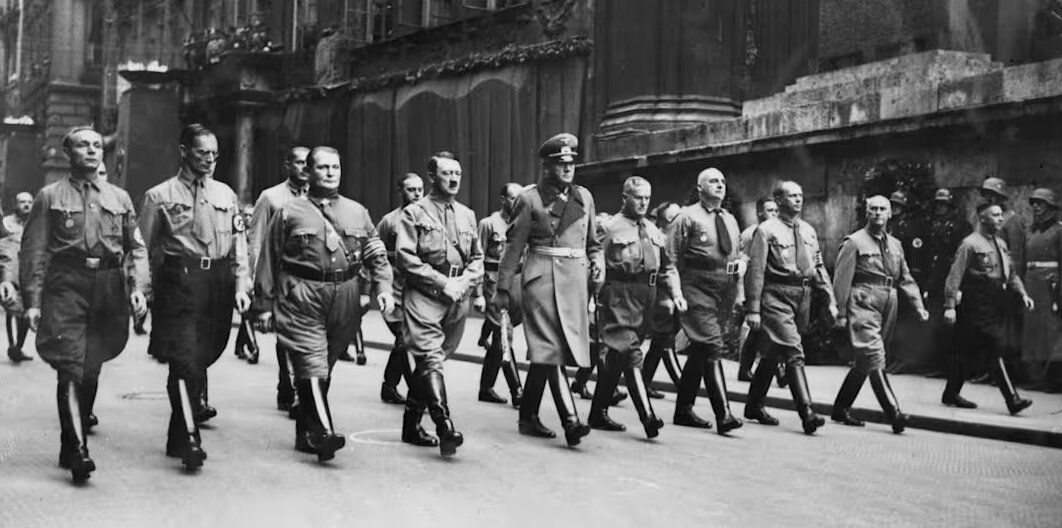


According to the news agency Online newson November 8, 1923 [۱۶ آبان ۱۳۰۲]Adolf Hitler entered the beer hall in Munich and by firing a pistol at the ceiling, he took the first step to overthrow the German democratic government. His attempted coup, later known as the “Beer Hall Coup”, failed almost immediately. Hitler was arrested and imprisoned, several of his supporters were killed and the Nazi Party was banned.
However, rather than dealing an irreparable blow to his position, Hitler’s failed coup actually helped further his sinister ambitions. Hitler himself later said about this: “Perhaps the failure of the coup was the greatest good fortune of my life.”
Germany after World War I; A troubled and weakened country
After World War I, Germany faced food shortages, violent uprisings by various political groups, and wounded national pride. Additionally, at least 1.7 million German soldiers had died in the war, and according to Hunter College history professor Benjamin Carter Hatt and author of The Death of Democracy: Hitler’s Rise to Power and the Fall of the Weimar Republic, “almost every family was mourning the loss of a loved one.”
By 1923, hyperinflation had brought the German economy to the brink of collapse. At the lowest level of the country’s currency, four trillion and 200 billion German marks were equal to only one US dollar. This situation caused the country to largely return to the system of exchanging goods with goods and the savings of the middle class were also destroyed. The situation became worse when France and Belgium, after Germany stopped paying war reparations, sent their military forces to this country; The reparations that Germany was obliged to pay based on the Treaty of Versailles. “It’s really hard to overstate the extent of the chaos and disorder in Germany,” says Hatt.
Hitler entered the political scene in such a chaotic atmosphere. He, who had left high school education half-finished and failed in art, at the same time had great skill in promoting and promoting himself. Born in Austria, the future dictator served in the German army during World War I before joining what would later become the Nazi Party. He took over the leadership of the party by 1921 and gave speeches all over Munich. In these speeches, Hitler attacked the Treaty of Versailles and held Jews responsible for Germany’s defeat in the war.
Beer hall coup map
Inspired by Benito Mussolini’s march to Rome in 1922, Hitler designed a plan to seize power in Munich, the capital of the state of Bavaria; An area that, according to Het, was at the time “a hotbed of fringe and extreme political activity.” After succeeding at this stage, Hitler planned to infiltrate what he called the “godless Babylon” of Berlin, overthrow the Weimar Republic and seize power. “When we look at this plan today, it seems completely stupid and unfounded,” Hatt said.
Hitler on November 8, 1923 [۱۶ آبان ۱۳۰۲] He implemented his plan. On that day, about three thousand people gathered for a public meeting in the Burgerbrückler beer hall in Munich. While Bavarian State Commissioner Gustav von Carr was addressing the audience, Hitler suddenly entered the hall, jumped on a chair and fired a shot into the ceiling to silence the crowd. “The national revolution has begun,” he announced while drenched in sweat.
At the same time, Hitler’s men surrounded the beer hall and blocked the way out by placing a machine gun at the main entrance. They also took several Jewish hostages, ransacked two printing presses, and destroyed an opposition newspaper.
Carr and two Bavarian military commanders were taken to a room behind the hall and threatened. The three finally agreed to join the coup. But they, who were also against the Weimar Republic, took a stand against Hitler as soon as they were freed from the coup plotters and informed the army and the state police of his plan. Hitler’s men also failed to take control of several important buildings, including an army barracks and a telephone exchange.
Seeing the collapse of the plan, Hitler and his accomplices on November 9 [17 آبان 1302] They started a massive march in the streets of Munich. But a group of Bavarian state police blocked their way and an armed conflict ensued. In this shooting, 15 of Hitler’s people, four police officers and a passerby were killed.
Hitler also suffered a dislocated shoulder during the conflict. A member of the Nazi Party, who was walking beside him, was shot in the chest and died. “Hitler survived this incident by sheer luck,” says Hett.
Hitler’s arrest
After the failed coup, Hitler went into hiding for two days until the police found him and transferred him to the Landsberg prison west of Munich.
The future leader of the Nazi Party was initially very depressed and even stopped eating. The German authorities had banned the Nazi Party, closed its newspaper, and arrested many of its leaders. In the eyes of many, Hitler’s political era was over. The New York Times wrote at the time: “The Munich coup will definitely put an end to Hitler and his National Socialist followers.”
However, Hitler gradually realized that prison had its advantages. One of the results of this experience was to change his way of gaining power. “He learned he couldn’t trust anyone outside his own party,” says Peter Black, a former senior historian at the United States Holocaust Memorial Museum who has been involved in the prosecution of Nazi war criminals.
Black also explains: “The beer hall coup showed Hitler that a government cannot be overthrown with a direct attack, but that it must be undermined from within.”
From then on, Hitler decided to rise to power mainly through democratic processes, not through violent revolution.
The failed coup and the subsequent trial, during which Hitler and nine other defendants were accused of high treason, received widespread coverage in the media and made his name nationally known.
The court judges gave Hitler a lot of freedom; So much so that one of them was heard to describe him as a “wonderful youth”. Hitler also used this opportunity and presented himself as a savior and a patriot who only wanted the good of Germany by giving long speeches in court.
“Hitler made good use of this opportunity,” says Black. He explains: “The issues that Hitler emphasized in the public arena, outside of his Nazi sympathizers, were the nationalist grievances of the Germans; Issues that many German people, even the Jews of this country, could empathize with.
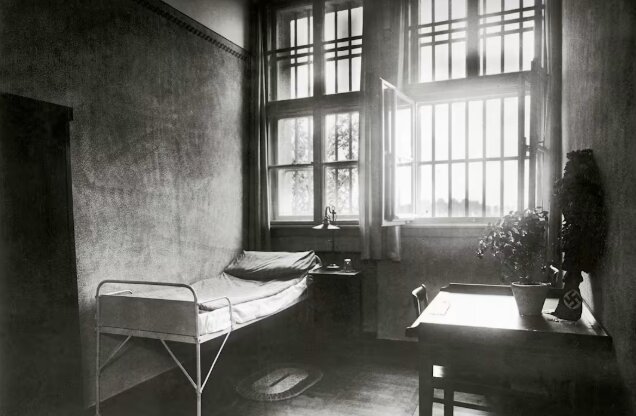
Photo: Magno/Getty Images
Hitler wrote Mein Kampf during his relatively light imprisonment
Ultimately, Hitler was sentenced to five years in prison, but could apply for parole after only six months. In addition, the court refused to deport him to Austria; The country where Hitler still had citizenship. The reasoning of the court was that he served in the German army and considered himself German; An argument that did not have a solid legal basis.
“All in all, his punishment was laughably light,” Hatt says. He adds: “The court did not have legal jurisdiction over this issue [اخراج هیتلر] to decide, but still issued such a ruling. “If Hitler had been kicked out of Germany at that time, the course of history might have really changed.”
Hitler, who had found a new spirit, returned to the Landsberg prison and began writing the first volume of the book My Battle; A book full of pseudoscience and an ideological statement that later became the basis for the mass killing of Jews and the invasion of Eastern Europe. Hitler later said that if he had not been imprisoned, My Battle would never have been written.
After the trial, a wave of visitors made their way to the Landsberg prison, and Hitler’s room was filled with letters, flowers and sweets. He was allowed to wear his own clothes, sit on a comfortable wicker chair and even make his bed for him. In his book 1924: The Year That Made Hitler, journalist Peter Ross Range described this period as “the easiest prison term for any convict in the state of Bavaria”.
Hitler’s return to the political scene after his release from prison
In December 1924, Hitler was released after serving only about a year in prison. He came out of prison with a lot of self-confidence, he believed in his greatness and superiority, he had gained more fame throughout Germany and he was on the verge of publishing his book. He also entered politics once again with a fixed world view and a new plan to gain power.
After returning to Munich, Hitler gave his first post-liberation speech at the Burgerbrückler beer hall, the site of the coup, where he declared himself the Supreme Leader of the reconstructed Nazi Party.
Although the Nazis still had only a small fraction of popular support, their rise to power had begun. This party was never able to win an absolute majority of votes, and its highest vote share was 37% in the parliamentary elections of July 1932. However, Hitler became Chancellor of Germany in January 1933; What happened was largely the result of the differences and conflicts of the left factions, as well as the support of influential conservatives who thought they could contain him in the form of a coalition government.
Hat says these conservatives had completely underestimated Hitler. “They didn’t understand how ruthless and cunning he was,” he explains. Hitler finally completed their work in a very short period of time.”…
Source: www.history.com
259




