



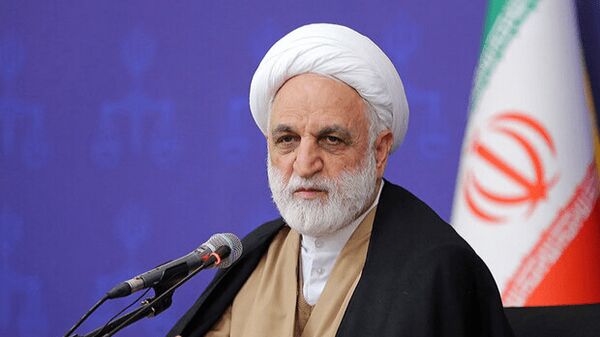


Hojjat-ul-Islamwal-Muslimin Mohseni Azhei, continuing his series of visits to judicial authorities and centers, on Tuesday morning, November 19, 1405, at the same time as the anniversary of the establishment of dispute resolution councils, with an intruding presence in judicial complex No. 7 of Tehran Peace Courts, visited various branches and departments of this complex.
According to Mehr, during his visit to some branches of this judicial complex, while reviewing the pending cases, he made recommendations and specialized orders to the judges and judicial staff. The branches visited by the head of the judiciary specialized in cases related to work accidents, driving without a license, traffic accidents, interference in the matter of legal representation and residence of illegal citizens.
During the investigation of one of the cases related to “delayed payment damages”, referring to the difference in the opinions issued by some courts regarding the method and time of calculating this damage, the head of the judiciary stated: a significant percentage of the requests to apply Article 477 are reserved for cases related to late payment damages; Therefore, it is necessary for the Chief Justice of Tehran province to adopt a suitable solution to resolve the differences and create a coherent procedure in this field, in coordination with the judicial and legal assistants of the judiciary and through the pathology of the existing processes.
In the continuation of the visit, Ajei examined one of the cases related to “driving without a license”.
After listening to the explanation of the judicial authority about suspending the fine of a significant part of the people who commit this violation for the first time, he clarified: that the fine of a significant part of the people who commit a violation or crime for the first time is suspended, has no clear logic and should not become a procedure. Our sentences and punishments must have the necessary deterrence.
Ajei, in another branch of this complex, conducted a case study of a serious case with the topic of “intervention in the matter of advocacy”. In this case, a person who claimed to be a lawyer was introduced to one of the parties by a legal institution; After studying parts of the case and hearing the explanations of the Chief Justice of Tehran Province and the investigating judge, Hojjatul-Islamwal-Muslimin Mohseni Ajeei, pointing to the necessity of effective monitoring of the activities of legal institutions, stated: these institutions must naturally meet certain conditions in order to receive a license to operate, and in case of violation, they should be dealt with and necessary measures should be taken regarding their license to operate.
In this regard, he emphasized that some of the reasons for the formation of judicial cases can be solved by reforming the processes within the judiciary, and added: “We can correct many issues ourselves in the judiciary.” We can prevent the formation of such cases and the occurrence of violations by modifying the laws or modifying the processes related to the registration of companies and institutions.
Referring to the financial and time costs of dealing with complex cases, the head of the judiciary stated: the conditions should not be such that any person can easily obtain a license to establish a legal institution; On the other hand, as soon as violations are observed and proven by these institutions, a proportionate and deterrent action should be taken against them.
In addition, referring to some issues that lead to the entry of a significant volume of cases into the judicial system, including interference in the matter of attorneys, driving without a license and late payment damages, he ordered the Chief Justice of Tehran Province to specifically follow up and analyze these issues; The head of the judicial system stated: It should be checked whether we need to amend the law to solve these issues or whether we should amend the punishments and guarantees of legal enforcement in a way that they have sufficient deterrence.
During his visit to various branches of judicial complex No. 7 of Tehran Peace Courts, he observed the limitation of the physical space dedicated to sitting and waiting for clients, and ordered that this problem be solved as much as possible so that clients face less difficulty and trouble when visiting the judicial complex.
In another part of this visit, Ajei followed up on the recruitment status of the dispute resolution councils who were accepted in the previous recruitment exam and issued specific orders to Hojjatul Islamwal Muslimin Mousavi, the head of the Dispute Resolution Development Center, regarding the acceleration of the assignment of these forces.
After visiting various branches and departments of judicial complex No. 7 of Tehran Peace Courts, during a speech to the judges and staff of this complex, he expressed his condolences on the days of martyrdom of Hazrat Siddiqa Taher (PBUH) and stated: Peacekeepers who are serving in peace courts and dispute resolution councils are considered among the unknown soldiers of the judiciary and their silent struggle in the path of peace is praiseworthy. Despite the budget, credit and even structural limitations, peacekeepers are taking steps towards peace and reconciliation of referred cases with firm determination and sincere effort.
The Head of the Judiciary continued, emphasizing the importance of reducing the proceedings in the peace courts, saying: shortening the proceedings in the peace courts is one of the main priorities. As much as the processes are shortened and the extravagances and formalities are reduced, accordingly, the volume of cases is also deducted and this has very important effects. In this regard, if there is a need to amend the law, necessary and appropriate measures should be taken.
While enumerating the effects and benefits of reducing the proceedings in the peace courts, he clarified: shortening the proceedings in the peace courts is like protecting the preventive function of this institution; Because every day of delay increases the distance of the parties from the point of balance of interests and reduces the possibility of compromise. Indeed, the speed of proceedings in the Magistrate’s Court is itself a mediating tool, not merely an administrative virtue.
The head of the judiciary considered the imposition of additional costs on the people and clients as a completely unacceptable issue in the judiciary and said: shortening the process of proceedings in the peace courts will cause clients to spend less time and money, and this is a basic principle and an important priority for the judiciary. We are against anything that imposes additional costs on people and clients.
He pointed out: On the other hand, it should be noted that in lawsuits referred to peace courts, the cost of long proceedings is not proportional to the subject of the lawsuit, which is, for example, financial disputes up to a certain amount. Therefore, shortening the handling process fulfills the principle of proportionality between “cost of handling” and “importance of the issue”.
Ejei continued his speech by explaining the blessings and social effects of reconciliation in lawsuits and stated: I have emphasized many times and I emphasize again that the blessing that lies in peace and compromise is not hidden in the judge’s ruling. When the parties to the dispute, with their own will and desire, compromise and compromise with each other and sometimes they fall short of their rights and rights, the ties of friendship and love between them are established and consolidated, and this brings great social effects. However, when the work of the litigating parties leads to the court and the judge’s ruling, the atmosphere may go towards usurpation and domination and, God forbid, perjury and inversion and falsification of the truth by each of the litigating parties and the parties involved.
The Head of the Judiciary stated: You peacemakers who are serving in the peace courts or dispute resolution councils, since you mediate and mediate for the reconciliation of the parties to the dispute, you are partners and involved in the blessing and reward of this blessed matter, and the light and blessing of this reconciliation will also cover you in social life.
He considered the cases in the peace courts to have a rich capacity for artistic and cinematic processing to publish social works of reconciliation and clarified: sometimes in the open and closed cases of the peace courts or dispute resolution councils, issues and subjects can be seen that really have the ability to be turned into films and documentaries. Topics and subjects that represent the promotion of the blessed phenomenon of “reconciliation” and “the past” and the effects of this in the improvement of social life. Some of the parties to the cases, despite the fact that they are entitled and their right is obvious, but for the love of Ahl al-Bayt, peace be upon them, they waive their rights. This forgiveness is truly enviable and instructive for members of the society.
In the final part of his speech in this meeting, the head of the judiciary issued specific orders to the competent officials to speed up the tasking of the dispute resolution councils and to carry out more diligent follow-ups in this field.