



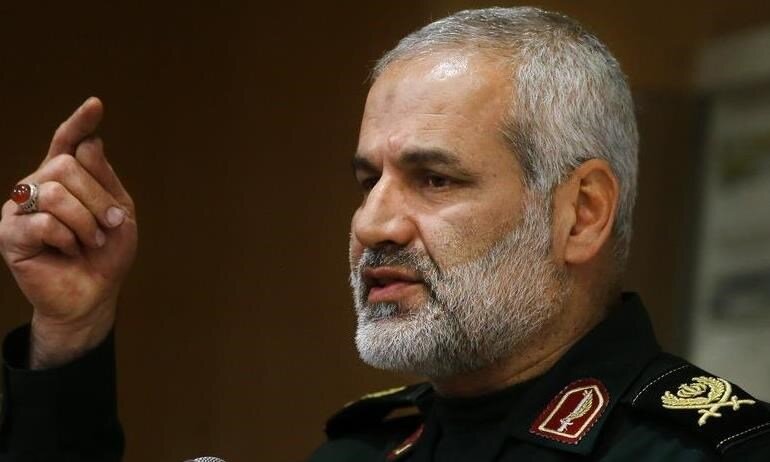



According to Khabaronline news agency, Sardar Ali Bilali, adviser to the commander of the Islamic Revolutionary Guard Corps Aerospace Force, in a conversation on the occasion of the day IRGC Aerospace Force, By explaining the formation process of the missile industry of the Islamic Republic of Iran, he discussed the role of Martyr Hassan Tehrani Moghadam in founding this industry, achieving independence in the design and production of missile weapons, and developing the country’s strategic capabilities.
According to the story of Fars, referring to the efforts of the enemies to weaken the defense power of the Islamic Republic of Iran, he said: At times, the enemies talked about the destruction of Iran’s missile industry, and now, after the second and third imposed wars, they are trying to insinuate that the country’s missile reserves have been exhausted. However, the missile industry of the Islamic Republic of Iran has reached a stage of maturity and self-sufficiency, where the continuation of production relies on domestic facilities and capacities.
The process of making and producing rockets in the Islamic Republic of Iran
Emphasizing the depth of localization in this industry, Sardar Bilali clarified: the manufacturing and production of missiles in the Islamic Republic of Iran is more localized than the manufacturing and supply of Iranian carpets.
Referring to the country’s possession of the primary resources needed for the production of various types of rocket fuel, the advisor of the commander of the IRGC Aerospace Force added: the raw materials used in the production of solid and liquid fuels are provided and processed by relying on domestic capacities, and Iran’s possession of mineral resources and petroleum derivatives has provided the basis for independence in this sector.
He pointed out: The rocket industry of the Islamic Republic of Iran, relying on the knowledge of domestic experts, has overcome its dependence on foreign countries, and now it is possible to manufacture all types of missiles needed by the armed forces in the country.
The formation of Iran’s missile power in the middle of an imposed war
Sardar Bilali, reviewing the history of the formation of missile power of the Islamic Republic of Iran, said: the starting point of the country’s movement towards achieving missile power goes back to the era of holy defense; The era when the Iraqi Baath regime, violating international rules and regulations, targeted the cities and residential areas of Iran with large-scale air and missile attacks.
He added: The continuation of these attacks and the need to create deterrence against the aggression of the Baath regime made the possession of missile weapons one of the basic needs of the country. In such a situation, Martyr Hassan Tehrani Moghadam, who was responsible for commanding the IRGC artillery, was commissioned to form the IRGC missile unit. A mission that was the beginning of the formation of one of the most important components of the defense power of the Islamic Republic of Iran.
Referring to the first steps of the training of missile forces, the advisor of the commander of the IRGC Aerospace Force stated: In 1363, a group of 13 people consisting of Martyr Hassan Tehrani Moghadam and a number of IRGC forces were sent to Syria and in a period of less than two months, they learned the necessary training to operate the Scud missile system.
Bilali continued: After the group’s return to the country, two launch pads and 30 missiles were received from Libya, and it became possible to start counter-missile operations against the attacks of the Iraqi Baath regime. One of the launch pads received at that time is now kept in the country’s missile achievements exhibition.
He stated that the possession of these equipments in the first stage placed Iran in the position of the operator of missile systems, and emphasized: Although these aids made it possible to respond to the missile attacks of the Baath regime, the dependence of the equipment and systems on foreign countries revealed the necessity of moving towards the acquisition of independent knowledge of missile design and production.
The role of Martyr Tehrani Moghadam in overcoming foreign dependence
Explaining the approach of Martyr Hassan Tehrani Moghadam in founding the country’s missile industry, Sardar Bilali stated: From the beginning, the strategic view of this martyr was that the Islamic Republic of Iran should not be satisfied with the use of weapons made by other countries, but should acquire the knowledge of designing, building and developing missile systems.
He added: Accordingly, two of the missiles received from Libya were given to a group of engineers to start the reverse engineering process by examining their structure and components and acquiring the knowledge to produce domestic samples.
The adviser to the commander of the IRGC Aerospace Force stated: These activities began in the difficult conditions of the imposed war, and despite the technical and equipment limitations, the effort to achieve the ability to independently manufacture missiles continued.
Referring to the cessation of cooperation with Libya after about two years, this former missile commander said: After the cessation of cooperation and the occurrence of disruptions in missile systems, Iranian specialists were able to use the knowledge and experience gained to fix the problems and make the continuation of missile activities possible without relying on foreign forces.
He continued: Finally, on 21 January 1365, one of the Soviet-made missiles that was provided to Iran through Libya was launched independently, relying on the power of Iranian forces; An event that was considered an important step in the path of establishing the operational independence of the country’s missile power.
Referring to the continuation of this path after the end of the Holy Defense, Sardar Bilali added: Scientific and technical cooperation with North Korea and some other countries provided the basis for knowledge transfer and development of domestic capacities, but the ultimate goal of these cooperations was to achieve complete independence in missile design and production.
He emphasized: With the continuation of research and industrial activities, the acquired knowledge was gradually localized and the Islamic Republic of Iran was promoted from the stage of using foreign systems to the position of an independent manufacturer of missile weapons.
From imported missiles worth 2.5 million dollars to the production of Iranian samples
Referring to the heavy cost of supplying missiles from abroad, the adviser to the commander of the IRGC Aerospace Force stated: At one point, missiles with a range of 300 kilometers were purchased from North Korea at a price of 2.5 million dollars per plane. While there was no need to use such expensive missiles to carry out some missions, including targeting positions at a distance of about 110 kilometers.
He added: Shahid Tehrani Moghadam, understanding this issue and with the aim of reducing operational costs and independently providing for the country’s defense needs, put the design and production of Iranian missiles on the agenda.
Sardar Bilali stated that acquiring the knowledge of making rockets was accompanied by many difficulties and failures, and stated: In the first stages of testing domestically made rockets, some launches would fail, and sometimes the rocket would explode in the sky after taking off from the launch pad; However, these failures not only did not stop the activities, but also provided the basis for identifying defects and completing technical knowledge.
Narration of an untold memory and hope of Iran’s missile father
The adviser to the commander of IRGC Aerospace Force said in describing one of the memories of that time: During one of the tests, the missile exploded in the sky after being launched, but instead of despairing, Martyr Tehrani Moghadam asked the troops to prepare for the pilgrimage of Imam Reza (AS).
He added: When the forces inquired about the reason for this decision considering the failure of the test, Shahid Tehrani Moghadam explained that the launch pad did its job properly and this success deserves attention. Therefore, while honoring the successful part of the experiment, the remaining problems should also be fixed.
Referring to another memory of early missile testing, Sardar Bilali said: In another test, the place where the missile fell was not determined and the efforts of the forces to find it did not succeed, but some time later, a soldier’s complaint about his camels being wounded in a desert area led to the identification of the place where the missile fell.
He continued: Shahid Tehrani Moghadam, after learning about this matter, considered finding the place where the rocket fell down as a valuable achievement and once again emphasized the need to appreciate the successes achieved.
The adviser to the commander of the IRGC Aerospace Force noted: Such an approach made laboratory and operational failures not become a factor to stop activities and every experience provides a basis for acquiring new knowledge and capabilities.
Converting an error of 20 kilometers to a hit accuracy of less than five meters
Referring to the effect of the initial tests on improving the technical knowledge of Iranian experts, Sardar Bilali said: The difficulty of determining the location of the fall of missiles and checking their performance revealed the necessity of developing measuring equipment and transmitting flight information.
He added: By using the systems of recording and sending flight information to ground stations, it was possible to check the performance of missiles more accurately and identify technical defects, and gradually, the accuracy of their hits increased.
The adviser to the commander of the IRGC Aerospace Force stated: The missiles that were faced with errors of about 20 kilometers in the early stages of development, as a result of the continuation of research activities, design modification and development of guidance and control technologies, became point-launching missiles.
Referring to the trend of increasing the range of Iranian missiles, Sardar Bilali said: The Soviet-made Scud missile had a range of about 300 kilometers in the prototypes, and the accuracy of hitting it in the best conditions was within a range of three kilometers in diameter.
He continued: Iranian experts, by acquiring the knowledge of manufacturing and developing these missiles, were able to gradually increase the range of production samples from 300 km to 500 km, then to 1150 km, and then to 2000 km.
Sardar Bilali emphasized that the increase in the range of missiles took place at the same time as their accuracy increased, and added: the development process of indigenous technologies caused the accuracy of hitting Iranian pinpoint missiles to reach less than five meters; An achievement that shows the significant progress of missile knowledge of the Islamic Republic of Iran.
Referring to the role of the youth and local experts in the realization of these achievements, he stated: The progress of the country’s rocket industry showed that the talent, knowledge and will of the Iranian youth can overcome the most difficult scientific and industrial obstacles and provide the basis for the achievement of advanced technologies.
The adviser of the commander of IRGC Aerospace Force, recalling the interpretation of the leader of the revolution that “missiles are the birth certificate of Iranian youth”, emphasized: these achievements are the result of the efforts of young people who, relying on their abilities, brought the country’s missile industry from foreign dependence to independence and self-sufficiency.
Going through reverse engineering and achieving the ability to design new missiles
In another part of this conversation, referring to the evolution of the missile industry of the Islamic Republic of Iran, Bilali said: the missile activities of the country were not limited to the reverse engineering of foreign samples, and with the expansion of technical knowledge, the field of designing and producing new missiles was provided in accordance with the operational needs of the armed forces.
He added: In the early stages, an important part of missile activities was focused on the development of ground-to-ground weapons to deal with fixed targets, but changing operational needs and the necessity of dealing with diverse threats put the design of missiles with specialized missions on the agenda.
Referring to the development of anti-ship missiles, the advisor of the commander of the IRGC Aerospace Force stated: Dealing with moving vessels and enemy ships required having weapons that, in addition to achieving a suitable range, also have the ability to identify and target moving targets.
In the same context, Sardar Bilali pointed to the “Persian Gulf” anti-ship ballistic missile and said: This missile is designed to deal with mobile sea targets by using an optical seeker and its range is 500 km.
He added: With the advancement of local technologies, the ability to produce missiles with a longer range has been provided, and the missile industry of the country has been able to develop more advanced systems in accordance with operational needs.
Hormuz missile design to deal with enemy radar systems
Referring to the development of specialized weapons in the country’s missile industry, the adviser to the commander of the IRGC Aerospace Force said: Another area of progress for Iranian experts is the design of missiles that make it possible to identify and target the enemy’s radar equipment by using the waves emitted from radar systems.
He added: “Hormoz” missile is one of the examples of this capability, which is designed with the aim of countering radar systems and has the ability to be directed towards the sources of the emission of radar waves.
Sardar Bilali emphasized: The acquisition of such technologies shows that the missile industry of the Islamic Republic of Iran has passed the stage of reproducing existing technologies and has reached a position where the country’s specialists can design and produce new weapons based on the needs of the battlefield.
He pointed out that this development is the result of years of research, experience gathering and development of scientific and industrial infrastructure, which started from the era of holy defense and continued with the efforts of successive generations of Iranian specialists.
Blockade and sanctions cannot stop Iran’s missile industry
Emphasizing that the most important legacy of Shahid Hassan Tehrani Moghadam is the institutionalization of the idea of independence and self-reliance in the country’s defense industry, Sardar Bilali said: The Islamic Republic of Iran started the path of developing its missile power with two launch platforms and a number of imported missiles, but now it has achieved the ability to design and produce all kinds of missiles, defense systems and drones.
He added: From the first years of cooperation with foreign countries, Shahid Tehrani Moghadam emphasized the need to transfer knowledge and achieve independent production capacity, and he believed that knowledge of existing technologies should be a prelude to designing and manufacturing indigenous equipment.
The adviser to the commander of the IRGC Aerospace Force emphasized the independence of the missile production chain in the country and clarified: if they surround our country with barbed wire and a concrete wall, they still cannot stop the production of Iranian missiles; Because this industry relies on local capabilities.
Sardar Bilali continued: The progress of the missile industry of the Islamic Republic of Iran showed that external restrictions cannot prevent the realization of the country’s defense goals, and relying on domestic capacities has provided the basis for the continued production and development of the weapons needed by the armed forces.
Emphasizing that today the Islamic Republic of Iran has the ability to manufacture the missiles it needs, he stated: the missile industry of the country is no longer limited to the manufacture of similar foreign models, but the ability to design and produce all types of missiles based on missions and operational needs has been formed inside the country.
In the end, the advisor to the commander of the IRGC Aerospace Force, glorifying the role of Martyr Hassan Tehrani Moghadam in the foundation of Iran’s missile industry, noted: By overcoming difficulties and turning failures into an opportunity for progress, this martyr paved the way to achieve one of the most complex defense technologies and showed that the will and knowledge of young Iranians can overcome obstacles that at first glance seem insurmountable.
29218