





According to the news agency Online news According to Ibna-Ali Nikoyi, Ph.D. in research arts and a senior expert in the history of ancient Iran: Mani appeared in a land that had significant diversity in terms of language and culture; In addition to Middle Persian and Parthian, the Sassanid Empire was connected with Aramaic, Syriac and other common languages in the territory of Iran and neighboring lands. This linguistic diversity was not only a social and cultural characteristic of this territory, but also played a decisive role in the formation and expansion of religious rituals. Mani, who considered his mission to be universal, had well understood that the religious message must inevitably cross linguistic boundaries in order to cross geographical boundaries. Therefore, the Manichaean tradition was linked with multilingualism from the beginning, and Iranian languages became one of the most important means of transmitting its teachings. The translation and re-creation of religious texts in different languages made it possible to communicate with different societies and allowed the religion of Mani to go beyond the environment of its first appearance, but this process was not limited to translation only; Iranian languages gradually contributed to the formation of Manichaean literature, terms and written memory. The basic question is, how did these languages become a tool for spreading and perpetuating Mani religion?

Ali Nikoyi
Mani and the linguistic origin of his thought
Mani grew up in a cultural and linguistic environment that had turned Mesopotamia and Sassanid territory into one of the important centers of religious and linguistic traditions of the ancient world; This area was the meeting place of Iranian, Semitic and Greek languages and cultures, and various religious traditions were present in it. In such an environment, Mani encountered a diverse intellectual and religious heritage, an environment where the Aramaic language and its branches had an important place in religious and cultural communication, and Middle Persian and Parthian were also widely used in the territory of Iran. It is not possible to speak with certainty about Mani’s mother tongue and the language with which he formulated his first thoughts, however, the Aramaic language environment of Middle River was very important in the formation of his thought. On the other hand, textual evidences show that Middle Persian became one of the important languages for writing and transmitting the teachings of this religion in the very early periods of Mani’s history. The Manichaean tradition also mentions the authoring of Mani’s works and the writing of texts to consolidate and transmit his teachings, including books that are known in the Manichaean sources with names such as “Living Bible” and “Treasure of Life”. The importance of this issue is revealed in the distinction between the mother tongue, the language of authorship, and the language of religious preaching; These three were not necessarily the same, and the use of one language in Manichaean texts should not be considered as a definite proof of Manichae’s motherhood or the composition of all his works in the same language. Middle Persian, with its lexical and written capacities, provided the possibility of conveying concepts such as light, darkness, liberation, and creation in a format appropriate to Iran’s cultural environment; Therefore, in Mani’s thought, language was not only a means of expressing a belief, but was considered a part of the process of formation, stabilization and transmission of a belief system.
Manichean line; A bridge between languages
One of the most important achievements of the Manichaean tradition was the formation and expansion of an independent writing system, which was later known as the “Manichean script”; This script had its roots in the Aramaic writing tradition and was considered a family of scripts that were popular in the cultural realm of the Near East. With the adaptation and transformation of Aramaic writing elements, the Manichaean script became a relatively coherent system that made it possible to record various languages. This script, like many Semitic scripts, was written from right to left, and a set of written signs were used to represent the sounds of different languages. The importance of the Manichaean script was that its use was not limited to a specific language, the surviving texts show that this script was used to write Middle Persian, Parthian, and Sogdian; Even in the more eastern territories, non-Iranian languages such as ancient Uyghur were also written with this script. Such a range shows that the Manuscript script gradually went beyond the scope of its primary religious uses and became a tool for transmitting texts in different cultural and linguistic environments. On the other hand, the use of Manuscript script in writing Iranian languages is of particular importance for linguistic research, Manuscripts provide researchers with valuable information about the vocabulary, grammatical structure, and phonetic features of these languages; Of course, it should not be assumed that this line represented all phonetic differences completely and equally, however, the way of recording words and its markings has provided the possibility of a more detailed examination of linguistic forms. Of course, a clear distinction must be made between writing and language; The Manaic script was a writing system, not an independent language, just as today you can write different languages with the Latin script, the Manaic script was also used for different languages; This feature made it a bridge between the linguistic world of Iran and the eastern lands.
Middle Persian, Parthian and Sogdian; The three linguistic pillars of Manichaean heritage
The spread of Mani religion in Iranian territories was deeply connected with the presence of three Middle Persian languages, Parthian and Sogdian; These three languages were not only the means of transmitting religious teachings, but they also played an essential role in the formation and preservation of the written heritage of Manavith.
Middle Persian was one of the most important languages of Manichaean religious literature, a significant part of the surviving Manichaean texts were written in this language and provide valuable information about Manichae’s worldview and belief system; Fundamental concepts such as light, darkness, creation, liberation, and the destiny of the soul are reflected in these texts with words and terms that are very important to study the language and thought of ancient Iran. Middle Manichaean Persian texts also provide the possibility of examining the evolution of religious words and how new concepts entered the Iranian language. From this point of view, Manichaean heritage is one of the important sources of knowledge of Middle Persian and its capacities in expressing complex philosophical and religious concepts.
The Parthian language also had a prominent place in the spread of Manichaeism. This language, whose history goes back to the linguistic tradition of the Parthian period, was popular in parts of the north and northeast of the territory of Iran and the surrounding areas. The spread of Mani faith in these areas created the need to transfer religious teachings to the language of local communities. Manuscript texts show that this language was used in the transmission of doctrines, religious narratives, and Manichaean hymns. The importance of these works is not limited to the history of Manichaeism; They are considered valuable sources of knowing the Parthian language, vocabulary, grammatical structures and part of the religious and literary culture of the Parthian world.
In the eastern part of the Iranian world, the Sogdian language played a decisive role in the spread of Manichaeism, the Sogdians were connected with various communities in Central Asia and East Asia through their commercial and cultural activities along the Silk Road; This communication network provided a suitable basis for the transmission of Mani’s religion. Manoic Sogdian texts show the widespread presence of this religion in the eastern environments and its compatibility with the language and culture of local communities, Sogdian gradually became one of the important languages for the transmission and reproduction of the Manoic tradition in Central Asia and even found a mediating role in relation to Turkic-speaking cultures.
In this way, Middle Persian, Parthian, and Sogdian formed three important branches of Manoist linguistic heritage; Three languages, each in a different geographical and cultural environment, helped to preserve and expand one of the most extensive religious traditions of the ancient world.
From Iranian languages to Uighur and Chinese; Translation and transformation of a ritual
The expansion of Mani religion to Central Asia and Eastern lands created a new stage in the history of this religion; The stage in which Iranian languages played an important mediating role in the transmission of teachings to non-Iranian societies. Manifestism gradually went beyond the limits of Iran and Mesopotamia, and on the commercial and cultural routes of the Silk Road, it found its way to lands that had significant differences from its original origin in terms of language and belief. One of the most important events of this period was the official acceptance of Manifestism in the Uyghur court in 762. In this process, Manuscript texts that were previously written in languages such as Middle Persian, Parthian, and Sogdian were translated into ancient Uyghur. These translations were not just the replacement of Iranian words with Turkish equivalents, the translators tried to recreate the complex religious and philosophical concepts of Manichaeism in the form of linguistic and cultural capacities of the new society. In this way, a number of terms related to creation, the world of light and darkness, the liberation of the soul and levels of existence entered the Uyghur religious literature. At the same time, some concepts found new forms in connection with indigenous words and intellectual traditions, this process led to the formation of Uyghur Manoic literature, which is considered one of the most important parts of the written heritage of this religion in the East.
Manifesto also found its way into the linguistic environment of China, the Chinese Manifesto texts, including the works that expressed the teachings of this religion with terms and thought forms familiar to the Chinese audience, represent another stage of this evolution. In these works, Iranian and Manichaean concepts came into contact with Chinese philosophical and religious traditions and found a different formulation to convey to new audiences; Of course, the path of transmission of these teachings was not always one-way. In some cases, Chinese texts were influenced by Parthian and Sogdian traditions, and in some cases Manichean concepts were mixed with Buddhist and Taoist elements. A clear example of trying to introduce an Iranian religious figure in the familiar framework of Chinese thought; Also, the translation of Parthian Manichaean hymns into Chinese shows that this transfer was not limited to the general introduction of teachings, but the literary and devotional works of Manichaeism were also recreated in this process. Therefore, the history of the spread of Manifestism in the East cannot be considered simply as the history of the spread of a religion in a new geography, this history is also the history of encountering languages, translating concepts and transforming intellectual traditions In each linguistic environment, while maintaining a part of its religious identity, Manivit entered into dialogue with the host culture and found a new form of cultural and literary life.
Manichaean heritage in the knowledge of Iranian languages
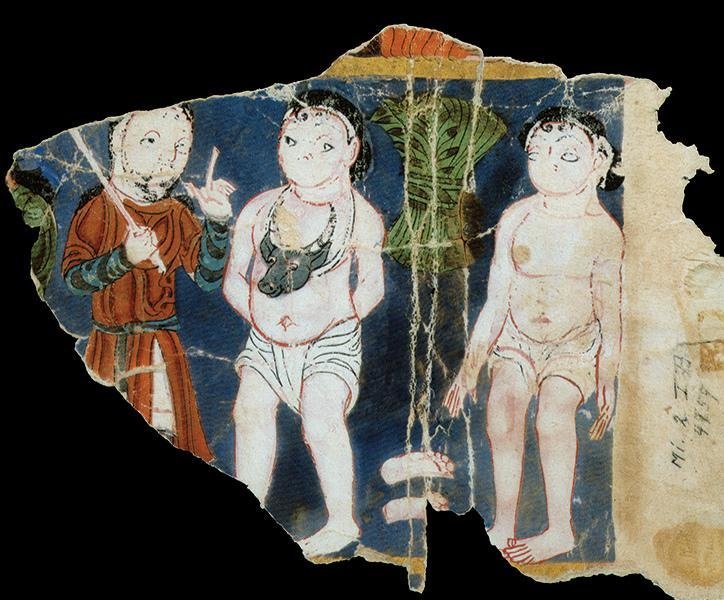
The discovery of the Turfan manuscript collection in the late 19th century and the beginning of the 20th century is considered a turning point in the knowledge of Middle Iranian languages and literature. These discoveries, which were found in the Turfan oasis in Turkestan, China, included a large number of Manichaean religious, literary and philosophical texts and opened a new horizon for the researchers of Iranian languages. The importance of these manuscripts is that a significant part of the works were written in Middle Persian, Parthian and Sogdian languages. In addition to preserving religious words and terms, these texts provide linguists with valuable examples of grammatical structure, sentence formation, lexical combinations, and historical evolution of these languages. In some cases, these works are among the few available sources for knowing some words and linguistic forms that are rarely seen in other surviving texts. On the other hand, Manichaean texts are not only linguistic documents, they are also important for understanding Iranian literature, worldview and thought before Islam. Manichaean hymns, mythological narratives, religious texts and educational writings provide an image of the way of expressing religious and philosophical concepts in Middle Iranian languages. Today, an important part of these works is kept in the collection of Turfan manuscripts of Berlin-Brandenburg Academy of Sciences, copies are also scattered in other collections such as the National Library of France and research institutions. The scientific study and publication of these documents is still important in understanding the linguistic heritage of Iran. In this way, Manifestism should be considered as one of the most important mediators of preserving and transferring the linguistic heritage of Iran to Central Asia; A ritual whose geographical expansion unintentionally led to the preservation of a large part of Iranian languages and literature.
the end of speech; When the language of memory becomes a civilization
How did a ritual become a multilingual heritage? The answer should be sought in the connection of three factors: first, Manifesto used Iranian languages, especially Middle Persian, Parthian, and Sogdian, to formulate and transmit his teachings; Second, the use of Manichaean script made it possible to record various languages in the form of a common writing system, and third, translation and cultural adaptation provided the basis for the spread of this religion in lands far from its origin.
These three features caused Maneuism to become more than a belief system and become an effective phenomenon in the history of language and culture; The surviving texts not only introduce us to Manichaean beliefs and thoughts, but also open a window to the linguistic and literary world of pre-Islamic Iran and its cultural links with Central Asia and East Asia. Therefore, Manichaean heritage should be considered a part of the written memory of Iranian civilization and the ancient world; A heritage that shows how a ritual can become a common memory of several cultures by crossing geographical and linguistic boundaries.
[i] A letter from Shahriar Zadeg, one of the religious authorities of the Manoist community, addressed to Aryamanpour, the teacher of the eastern district; Written in Sogdian and Farsi languages and discovered in cave number 65 of Bizklik Caves in Turfan. This document is an example of multilingualism in the religious communication of Central Asian Manichaeans.
[ii] Fragment of a Manichean historical text in Parthian language and Manichean script, containing an account of the death of Mani in Bilabad (Gandishapur), Sasanian Khuzestan. This document is an important source for the study of the Parthian language and the history of the Manichaean tradition. Edition ID: M 5569, Turfan Collection Berlin.
259



