





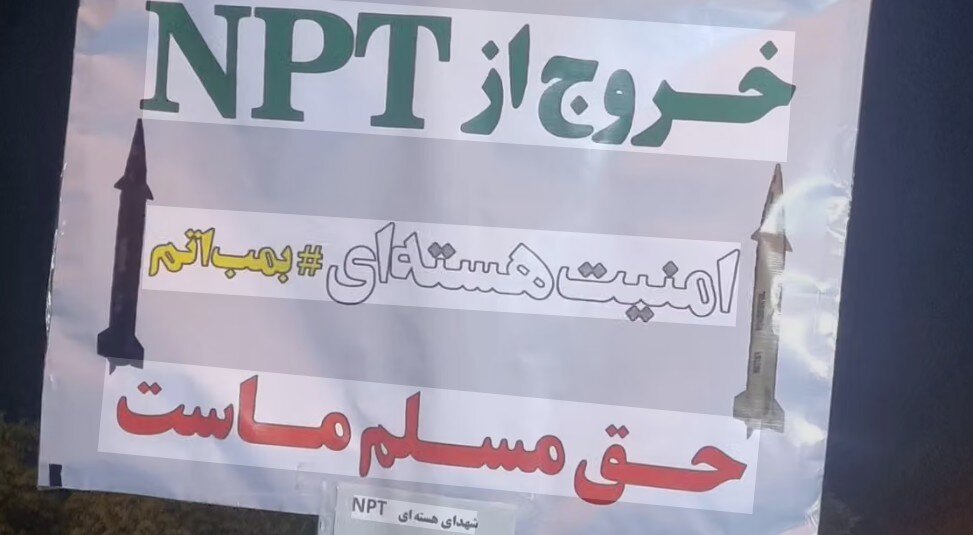
Online news – The issue of Iran’s withdrawal from the Nuclear Non-Proliferation Treaty has once again become one of the controversial issues in the country’s political environment in recent months. After the US and Israeli military attacks on Iran’s nuclear facilities and criticism of the performance of international institutions, a number of parliamentarians and political figures called for a review of the country’s nuclear policy and even withdrawal from the NPT. In the meantime, some Friday imams have attributed this demand to the people and mentioned it as a national demand.
Hojjat-ul-Islam Mohammad Javad Haj Ali Akbari, the interim Friday imam of Tehran, said on the 8th of November in his Friday prayer sermons, stating that the revision of the nuclear doctrine has become a demand of the Iranian nation. More than 70% of people in some polls have called for a revision of the nuclear doctrine. He also spoke about the formation of a wave of requests among different sections of the society and emphasized that expert proposals should be presented to the leader of the revolution and any decision he makes will be the basis of action.
Previously, on the 17th of October, Haj Ali Akbari spoke about the necessity of leaving the NPT in his Friday prayer sermons in Tehran. Also, Hojjat-ul-Islam Sayyed Ali Hosseini, Imam of Juma Deir, on the 13th of Aban, described withdrawal from this agreement as a clear and definite demand of the Iranian nation.
But here is the main question: What measurable data about public opinion are these statements based on? Is there a specific survey that shows that the majority of Iranian people want to leave the NPT? And can supporting the change of the nuclear doctrine be considered equivalent to agreeing to withdraw from an international agreement?
The confusion between changing the nuclear doctrine and withdrawing from the NPT
One of the most important objections to these statements is equating two different issues: changing the nuclear doctrine and withdrawing from the Nuclear Non-Proliferation Treaty.
For example, in his statement on November 8, Haj Ali Akbari spoke about surveys based on which more than 70% of people wanted to revise the nuclear doctrine. However, he did not announce the name of the organization organizing these surveys, nor did he specify the time of conducting them, nor did he explain about the statistical population, the number of participants, and the exact form of the question.
More importantly, even if we use this statistic as a basis, we cannot conclude that 70% of the people want to leave the NPT. Revising the nuclear doctrine can encompass a wide range of policies and approaches and does not necessarily mean withdrawing from an international treaty.
This distinction is also important in the review of published surveys. For example, the Iran Public Opinion Institute at the University of Maryland, in its report on the March 2024 poll, asked a specific question about people’s agreement or opposition to withdrawing from the NPT with the aim of obtaining nuclear weapons. According to the results of this survey, 40% of the respondents agreed with such an action and 50% disagreed. Of course, this survey is from 2024 and its results cannot be generalized to today’s conditions; But this same example shows that even in a specific issue such as withdrawing from the agreement, a distinction must be made between different questions and their results.
Therefore, relying on polls with the revision of the nuclear doctrine to prove the public desire to withdraw from the NPT is methodologically unreliable.
A political position does not mean an official decision
Another issue that should be considered in the review of these statements is the difference between proposing a political demand and making an official decision in the country’s foreign policy and national security.
In recent months, some MPs have also demanded Iran’s withdrawal from the NPT. According to Tasnim’s report, on October 29, the issue of withdrawing from this agreement was raised in the parliament and plans in this regard were also followed up. At the same time, Mohsen Rezaei, the secretary of the Supreme National Security Council, announced on the 9th of November that no new official and governmental decision has been made regarding the change of the nuclear doctrine.
Esmail Beqaei, the spokesman of the Ministry of Foreign Affairs, on November 18, in response to a question about withdrawing from the NPT, emphasized that Iran is still a member of this pact and considers itself to be committed to its obligations. He made a distinction between the debates raised in the public space and the decision-making level of the country. On the other hand, even the November 21 statement of the Assembly of Experts, in which the examination of the issue of withdrawing from the NPT is raised as a public necessity and demand, does not mean making a decision to withdraw from this treaty. A request to review an issue is different from a final decision on its implementation.
What institution is responsible for the decision to withdraw from NPT?
Leaving the NPT is not an ordinary decision or just the result of a media and political demand. This issue is directly related to Iran’s national security, foreign policy, defense strategy and international relations, and it is decided at the highest level of the system.
According to Article 176 of the Constitution, the Supreme National Security Council is responsible for determining the country’s defense and security policies within the scope of general policies determined by the leadership, and the council’s approvals are enforceable after the approval of the leadership. Therefore, the statements of parliamentarians, Friday imams or other political figures, even if they have official and important positions, do not by themselves express the final decision of the system to withdraw from this pact.
The more important thing is that Haj Ali Akbari himself had stated in his statement on the 8th of Aban that expert proposals should be submitted to the leader of the revolution and that any decision he makes will be the basis of action. This part of his statement clearly shows that even from the speaker’s point of view, raising this issue as a public demand is not the same as making a final decision about it.
result
The claim of some Friday imams that withdrawing from the NPT has become a general demand of the Iranian people cannot be confirmed without providing a specific, evaluable survey with a clear methodology. Especially, in some statements, the statistics related to the support for the change of the nuclear doctrine have been presented as if it directly indicates the people’s agreement to withdraw from the NPT; While these two issues are not necessarily the same.
This assessment does not mean rejecting the existence of such a demand in a part of the society or ignoring the gatherings and positions of the supporters of withdrawing from the treaty; Rather, the problem is to generalize the positions of a part of the society to the whole people without providing statistical documentation. Finally, it should be emphasized that the decision about Iran’s withdrawal from the NPT is not in the hands of Friday imams, nor is it finalized by the announcement of a demand by a group of representatives or citizens; This decision will be made in the framework of the high mechanisms of national security and macro policy of the system and with the decisive role of the leadership position.
3131



