



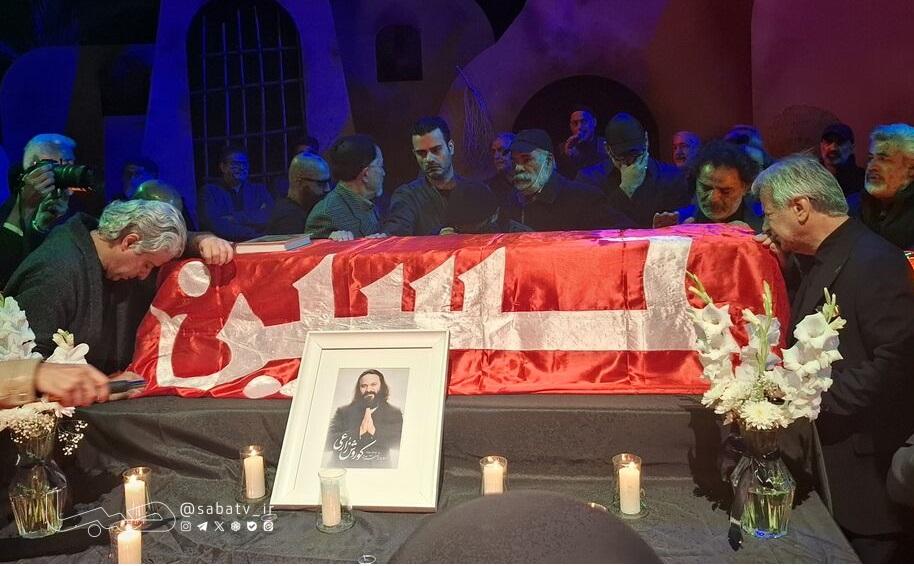


Gezrash Saba from the funeral ceremony of Korosh Zarei in the field of art;
From stage memories and years of cooperation to the narrative of friendship and commitment; At the farewell ceremony of Korosh Zarei, artists and cultural directors spoke of a figure who did not hide his beliefs and lived the theater with all his heart.

According to the reporter of Saba, On the morning of Tuesday, November 19th, the Andisheh Hall of the Art Center was the scene of the last meeting of colleagues and friends with Korosh Zarei; An actor and director who spent many years of his professional life in the field of theater and now he was sent away among a group of artists, cultural directors, his family and lovers.
The funeral ceremony of this artist’s body started at 9:30 in the morning with the presence of a group of cultural and artistic figures. Hojjat-ul-Islam Mohammad Qomi, head of the Islamic Propaganda Organization, Mohammad Mehdi Dadman, head of the art department, Peyman Jabali, head of the Broadcasting Organization, Raed Faridzadeh, head of the cinema organization, Fadel Nazari, Ehsan Mohammad Hosni, Majid Shahhosseini, Hamid Shahabadi, Shahram Karmi, Hossein Parsaei, Ayub Aghakhani, Atabek Naderi, Siros Hemti, Asghar Khalili and a number of other artists and managers were present in this ceremony. Zarei’s wife, his children and his mother were also present in this ceremony.
Before the official start of the ceremony, Zarei’s body was transferred to Andisheh Hall and the attendees welcomed this farewell by chanting and playing music. After reciting verses from the Holy Quran and playing the anthem of the Islamic Republic of Iran, pictures of his role-playing and artistic activities were shown along with stories from his colleagues.
Najmuddin Shariati performed the ceremony. Referring to the difficulty of speaking in such a situation, he considered Zarei as an artist who worked with commitment and belief in the field of art and said that today a group of his companions have gathered to see him off.
Amir Hossein Shafiei, the director of the Performing Arts Center of the Art Department, also welcomed the attendees at the beginning of the ceremony, and appreciated the support of the directors of the art department and the theater family with Zarei during the days of his illness and until the last moments of his life.
Hossein Parsai said about friendship that did not change even with illness
One of the parts of the ceremony was devoted to the narration of Hossein Parsaei’s memories of his years of acquaintance and cooperation with Zarei. Referring to the artist’s enthusiasm for theater and religious performances, he said: I closely witnessed Cyrus entering the field of art and I saw how he worked with love and his heart beat for theater.
Emphasizing Zarei’s personal character, Parsai continued: He was never one to complain. Even in our last meeting, when he was struggling with pain and illness, I did not hear anything from him except thank God. He was kind and had no grudges.
He also mentioned Zarei’s professional path from Minab to appearing in the field of performing arts and said that his works with religious themes and devotion to Ahl al-Bayt were known beyond the borders of Iran.
Recalling Zarei’s religious sensibility in performing theatrical works, including the show “Banovi Bishanhan”, Parsai added: “He did not go without ablution to appear on stage in many of his works.” The field of art was not just a place of work for him; It was a house to which he belonged. I saw nothing but humanity from him and I believe that his works will remain in our minds and hearts.
Jabali: An artist must stand by his beliefs
Peyman Jabali, the head of the Broadcasting Organization, emphasized the relationship between art and social responsibility and considered Zarei as an example of artists who use their professional abilities in the direction of their beliefs and ideals.
He said: The artist is responsible for someone who puts his skill and ability in the path of his beliefs and uses the influence and influence of art to guide thoughts; Even if choosing such a path means losing some financial opportunities.
Jabali, referring to the beginning of Zarei’s artistic activity since he was a teenager in Minab, considered his acting in dramatic and visual works and his appearance in the series “Youssef the Prophet” as among the activities that made him known in the artistic community.
The head of the Broadcasting Organization also mentioned Zarei’s pursuits for the development and internationalization of religious, resistance and revolutionary theater and said that this artist was pursuing his concerns even in the last months of his life.
Emphasizing the necessity of providing opportunities for committed artists, he expressed hope that Zarei’s efforts and achievements in the field of performing arts will continue.
Pourkrimi: It’s good that Cyrus is more awake than all of us
Hossein Pourkarimi, an actor and one of Korosh Zarei’s students, spoke about his experience of being a student and working with him during the ceremony. Referring to the phone call a few days before Zarei’s death, he mentioned the difficulty of facing the loss of this artist and said: I called to talk to him a few days ago, but they said he was in a lot of pain and was sleeping. It’s good for Cyrus that you are more awake than all of us.
In another part of his speech, Pourkarimi talked about the experience of performing the show “Arvand Khoon”; A work about the diver’s martyrs, whose performance had significant performance difficulties due to the use of 46 thousand liters of water on the stage.
Referring to Zarei’s follow-up and persistence for the completion of this show, he also said about the effect of his presence in the artistic space of the art field: With the arrival of Korosh, everyone’s situation became better and the actors were no longer categorized.
Fazel Nazari: He was himself
Fazel Nazari was another speaker of this ceremony who started his speech by reading a poem and then spoke about Zarei’s personality traits.
Referring to the difficulty of returning to shared memories with an artist who is no longer present, he said: Korosh Zarei was one of those people for whom it is not easy to find another example. He was an actor, director and executive, but most of all, he was himself.
Emphasizing Zarei’s frankness and monotony in his personal and professional life, Nazari added: If he believed in something, he would not hide it. At a time when many people hide their beliefs behind masks for small interests, Cyrus was unmasked. He was not hypocritical and showed his real life as it was.
Referring to Zarei’s migration from Bandar Abbas and the place he found among his colleagues, this poet said: Cyrus was a stranger and came here from Bandar Abbas, but he behaved so warm and friendly as if we were his guests.
At the end, Nazari pointed out the meaning of death and its effect on human’s view of life, emphasizing that the loss of such people will remain in the minds and memories of those around them for a long time.
Aghakhani: Zarei proved that you can be an artist and live a healthy life
Ayoub Agakhani, theater director and actor, referring to more than three decades of friendship with Korosh Zarei, considered his most important legacy not only his artistic career, but also his lifestyle and professional character.
Stating that talking about Zarei is not an easy task, he mentioned a memory of his and Amirhossein Shafi’i’s introduction ceremony in the field of art and said: At the same time, I said that talking about Korosh Zarei is talking about a phenomenon.
Emphasizing that Zarei’s fame in neighboring countries due to his presence in the series “Youssef the Prophet” or his theatrical activities, Aghakhani only shows a part of his artistic identity, adding: “For me, what is more important is his way of life.” Zarei wanted to show the new generation that it is possible to be an artist and live a healthy life, to be a cultural director and not to play politics and not cross moral principles. At a time when our world is empty of role models and myths, he could still be a role model.
This theater artist considered Zarei to be an example of ethics in cultural management and ritual art and continued: He showed that it is possible to work in religious and religious performances and at the same time put ethics at the forefront of the work. You can work, listen to criticism and finally even the critics will bow before your credit and performance. This kind of victory is truly enviable.
At the end, Agakhani criticized general judgments about the art community and stated: Those who accuse the art family of being unhealthy with unfair views and media tools, why didn’t they look at the life and character of a human like Korosh Zarei?
Qomi: Zarei’s popularity in the countries of the region was the result of years of artistic activity
In the continuation of the ceremony, Hojjat-ul-Islam Mohammad Qomi, the head of the Islamic Propaganda Organization, referring to Zarei’s personality and professional characteristics, described him as a committed, morally oriented artist with a brotherly spirit.
Stating that many of the attendees felt close to him due to Zarei’s sincerity and openness, Qomi talked about the experience of his joint trips with this artist to the countries of the region and added: “During our trips to Basra, the Iraqi people’s reception of Korosh Zarei was very memorable for me.” He was also welcomed in various countries including Turkey, Lebanon, Iraq, Tunisia and Syria, and he appeared as a well-known and popular artist.
The head of the Islamic Propaganda Organization considered modesty and purity of behavior to be one of Zarei’s outstanding characteristics and said: His sincerity was not only in his words, but it was clearly seen in his behavior and dealings with others. When he came to visit me, he said with self-respect that he came because of heartache and had no demands.
He further mentioned some of Zarei’s concerns in the field of cultural management and said that one of the issues that this artist talked about many times was the lack of attention to the capacity of women in the field of art. Zarei believed that there are valuable talents and assets in theater, which is called as the mother art, which should be given the opportunity to be more present and active.
Qomi also spoke about Zarei’s cross-border view of art and added: He believed in the cultural capacities of Iran and the countries of the region and put forward serious plans and proposals for the development of Quranic and artistic activities in the field of resistance. His concerns were not limited to everyday issues; He was the owner of thought and vision and knew how art can be influential outside the borders.
A manager who found a way to overcome obstacles
In another part of his speech, the head of the Islamic Propaganda Organization discussed Zarei’s managerial abilities and described him as a persistent, efficient manager who is far from formalities.
He said: Zarei was not one for show and administrative ceremonies. If he faced an obstacle, he would not stop and find a way to overcome it to achieve what he believed in. When he succeeded, he would happily come back and say, “It’s done.” Of course, along with these successes, he also talked about the obstacles in the administrative structures and believed that a solution should be found to solve them.
Referring to Zarei’s spirit of responsibility and his readiness to accept the cost of his decisions, Qomi mentioned that some theatrical events, including the theater festival of 1401, were important experiences of his career.
He considered the combination of managerial ability, compassion, politeness and humility to be among the characteristics that distinguished Zarei among his colleagues and said: this set of characteristics, along with his strength and standing, made him a remarkable character.
Farmer’s concerns continued until the last days of his life
Referring to the last days of the artist’s life, Qomi spoke about his spirit during his illness and stated: “Zarei was fond of remembrance and remembrance of God even during the difficult days of his illness and spoke less about his suffering and pain.” He kept talking about the horizons ahead and the plans we were going to follow in the future. He tried to motivate those around him and keep their spirits up.
Emphasizing that artists with such characteristics are not easily replaced, he pointed to Zarei’s role in supporting younger groups and added: He created opportunities for new generations of theater; From mosque theater activities to programs and performances related to Arbaeen. I hope that this path will not stop and that more young people will enter this field.
In the end, the head of the Islamic Propaganda Organization pointed to the red flag of “Ya Hossein” on Zarei’s body, asked for his forgiveness and expressed hope that the artistic and cultural heritage of this artist will remain alive in the way of the activities of young groups and dedicated theater.




