



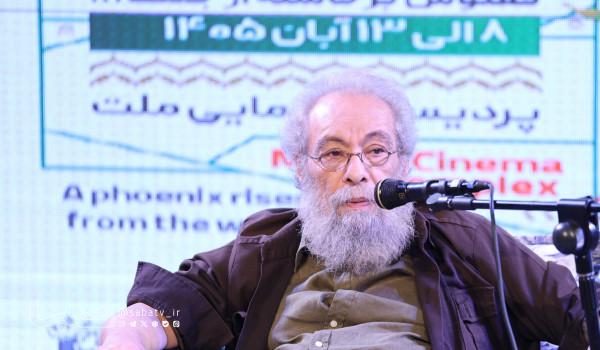


Masoud Frosti in the experience transfer workshop “Resistance Film Criticism; From Experience to Pathology” Emphasizing that cinema first of all needs to master the technique and reach the form, he said: the cinema of the holy defense during the war years had the capacity to become the national genre of Iran; But today, in order to rebuild the cinema of resistance, we must study cinema seriously and strengthen the culture of criticism and acceptance of criticism.
According to Saba According to the public relations of the International Resistance Film Festival, on the evening of Friday, November 8, on the first day of the 19th International Resistance Film Festival, a workshop on the transfer of the experience of film critic Masoud Frosti was held at the Mellat Cinema Campus with the presence of a large number of enthusiasts, students and film lovers. This meeting focused on “Criticism of Resistance Film; From experience to pathology” was devoted to topics such as the definition of resistance cinema, the experience of sacred defense cinema, the ratio of form and content, the place of technique in filmmaking, the necessity of studying for an artist, and the importance of criticism.
First we have to learn cinema
In response to the question of one of the attendees at the meeting, Frosti said: “Before these divisions, we must clarify what cinema is and what is our claim in cinema.” The main issue is that we still have to learn cinema. Americans know cinema and this mastery of media language has made them able to be effective in the world. When I say a movie is good, I’m not necessarily talking about whether it’s moral or immoral; I mean, the builder knows what he’s doing. If we want to be effective in today’s world, the first step is to learn cinema seriously and professionally.
He said: “During the eight-year war, we had something called holy defense cinema, which in my opinion had the capacity to be our national genre. That cinema was not necessarily mature at the beginning, but it produced people and experience and formed part of our national discourse. Filmmakers came out of this space and works like “Didehban” and “Mohajer” can be examined in the same direction. The problem is that that stream does not exist today in that living and growing sense.
Resistance should not be limited to war
Frosty said: Resistance is not only about war. A person without resistance has no meaning at all. Resistance can be against a wrong idea, against a situation that stops a person or against a situation that does not allow growth. If we limit the concept of resistance only to the battlefield, we have reduced its human and social scope. Criticism is life; Society should be trained to be criticized, he said: Criticism is the basis of work; In war, peace and any other situation. To say “don’t criticize now because there will be a difference” is not a correct logic. When differences are not spoken, they are only hidden. Criticism is necessary and vital. At home, school, university and society, we must criticize and be ready to be criticized. No one should consider himself immune from criticism. These fake definitions of each other and constant compliments do not move us forward.
He went on to emphasize the link between resistance and criticism and added: Man has no meaning without resistance and no meaning without criticism. Resistance and criticism are the two wings of the movement. Someone who always just says “yes” may stabilize the status quo; But saying “no,” even if it’s sometimes accompanied by mistakes, can allow for movement.
Not every joke is a comedy
This film critic answered the question, “What is your assessment of the dominant state of Iranian cinema today?” He also said: An important part of what is presented as a comedy today is not necessarily a comedy. They say that people are tired and want to laugh; OK, I’m a fan of comedy myself, but the question is, what are we laughing at and in what quality? Not every joke is a comedy. Comedy, like any other serious genre, needs knowledge, technique and form. In the holy defense cinema, works like “Lili Ba Man Is” or “Bulletproof” are examples that can be discussed more seriously about their comedy quality.
Content is built with form
Frosti added: I have a problem with the common definition of “content”. The theme and idea are there, but the content is not ready and independent of the form in the work of art. Content is built with form. It is the form that allows an idea or theme to become artistic content. Therefore, completely separating the form from the content and saying that “I agree with the content of the film but not with its form” is not always accurate; Because the form is creating what we will later call the content. Without technique, claiming form is a joke.
This author and researcher in the field of cinema answered the question, “If the form is personal, can any filmmaker justify the weaknesses of his work with the phrase “my form is this”? He also stated: No, before form, there is technique, and technique is the alphabet of work. In cinema, one should know camera, lens, light, mise-en-scène and professional tools. Someone who doesn’t know technique and says, “That’s my form,” actually has nothing to defend. Without technique, we will never get in shape. Some of the initial mistakes of our films show that sometimes these technical bases are not taken seriously. We learn the technique to get through it.
He added: We learn the technique so that we can pass it. This does not mean forgetting technique; Only one can pass the technique who has learned it to the end. If the technique is a burden on the artist, it remains at the same stage as a technician. He may know the light or the camera very well, but the work has no life. Art begins when the tool is completely at the disposal of the artist and he can achieve the form.
Form is not learnable; It is livable
Frosti said: technique can be learned, but form is not the only thing that can be learned; It is livable. The form comes from the lived world of the artist and develops in his unconscious. Knowledge and technique are the support, but in the end it is the artist’s life style and encounter with the world that makes it possible to reach the form. Simply put, technique deals more with the mind and consciousness, and form with a deeper part of human experience and perception. Reason is not removed; Reason takes a light for this perception, but it does not take its place. A filmmaker is not made by watching a few films.
He said: Studying the literature and history of cinema plays an essential role in the formation of a filmmaker. A filmmaker cannot get the necessary support just by watching a few films. You should read the classics of world literature; Dostoevsky, Balzac, Dickens and others. In the cinema, you should also see the works of important filmmakers; From John Ford and Hitchcock to Bergman. These should be behind the artist. If the literary and cinematic support is empty, tools and claims do not take the place of experience and knowledge.
Contradiction is the movement engine of work and life
Frosti added: Every phenomenon in the world is full of contradictions, and movement is formed from contradictions. Each person has different conflicts with himself and his society, but at any moment one of them is major. We are not looking for a real solution until we find the major conflict. The artist must also be able to see the contrast in people and situations; Because if the contrast is removed, a large part of the movement and life of the work is lost.
Form is not a straight line
In response to the question “Does the form have specific rules or is it completely intuitive?” He stated: The form is not irregular. The form has movement and arc and feeds on contrast. A work that is just a straight line is not alive. What creates pleasure for the audience when facing art comes from the quality of the form. I don’t go to art just to see technique; I go to experience and enjoy. The artist must also be able to create a work that the audience can have such an experience. A personal form is different from a duplicate signature.
This film critic stated: The form should not be confused with a few external signs or repeated signatures. The form comes from the life of the artist and sometimes it takes time to get the right image, color, mise-en-scène or tone. A serious artist does not have a ready version for every work. The form is real when it comes out of the heart of experience, technique and biological effect.
The language of cinema should be adopted like the language of translation
In response to the question “Why do you use the example of translation to explain technique and form?” He stated: Because the translator must first know the source language and the target language correctly. A person who does not know Farsi well, even if he knows a foreign language, is still not a perfect translator. But this recognition is only a technical basis. The next step is where the translator engages with the text and finds a live and correct equivalent in the target language for the words and sentences. In cinema, one must first learn the language of cinema and then make it one’s own.
Art must be able to find its audience and economy
He said: Art should be able to have its own audience and economy. It is a serious matter for an artist to work outside of his profession and spend the income again on theater or cinema. Artwork is not meant to be just for the creator. The artist should enjoy creating the work and create a work that the audience can relate to.
Being critical is a way of life
Frosti added: Creditworthiness does not have short instructions; It is a way of life. A person should constantly question himself and not see himself as a finished being. I say don’t feel sorry for yourself; Don’t be the same person as you were yesterday. Not a day goes by that you don’t read something new, learn something, or re-evaluate yourself. This is where the possibility of movement begins.
The 19th International Resistance Film Festival will be held from the 7th to the 14th of Aban 1405 under the direction of Jalal Ghafari at Mellat Cinema Campus.




