



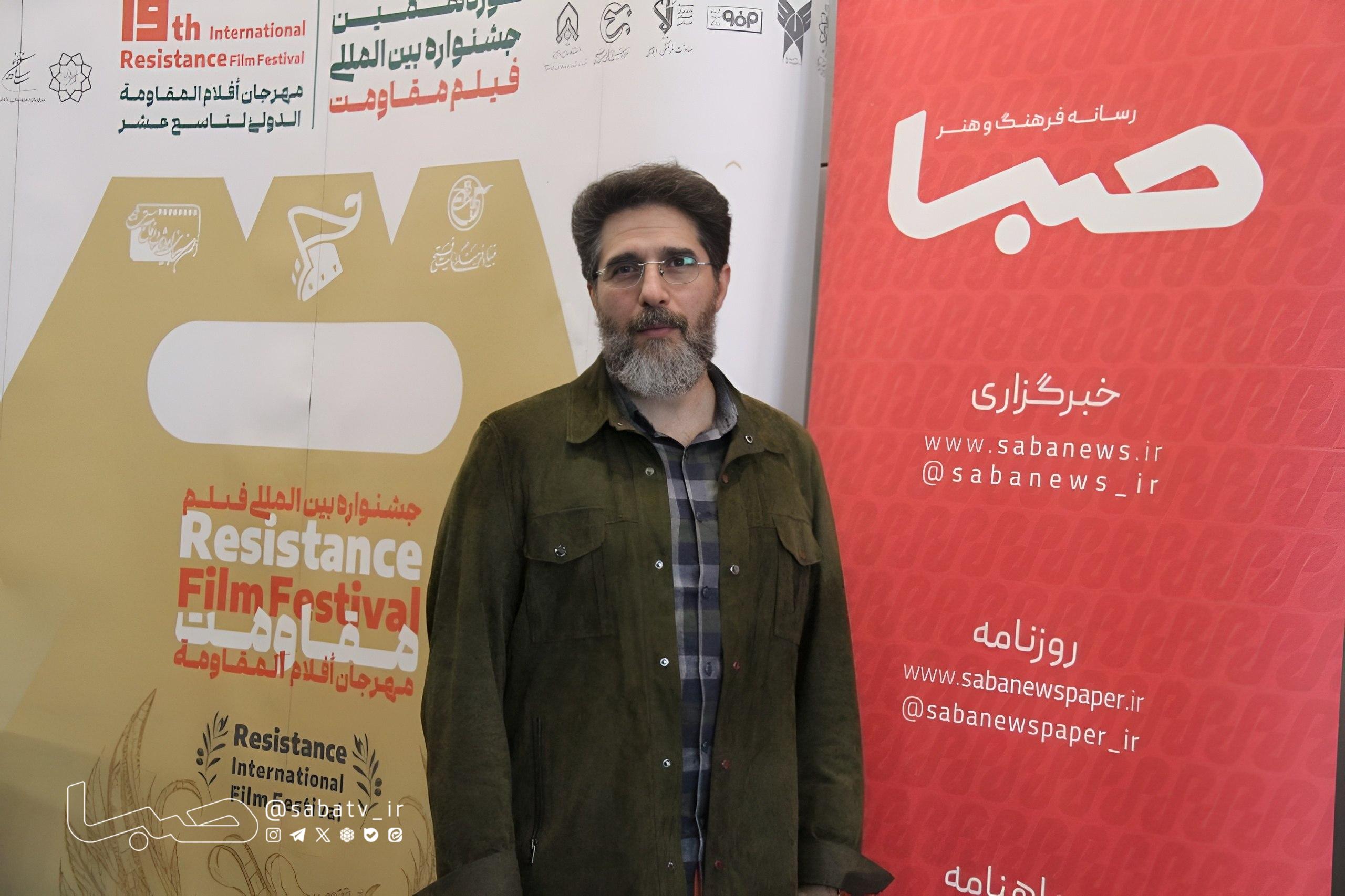


Mohammadreza Misbah, writer and producer of cinema, emphasizing the necessity of resistance cinema to distance itself from repetitive patterns and reach believable narratives of war and resistance, believes that in order to maintain its connection with the audience, especially the young generation, this cinema should change its language and narrative method according to the needs and social developments.
Nasser Arbab/Saba, The 19th International Resistance Film Festival will be held in a situation where the issue of war, resistance and the representation of social and human realities has become the focus of attention of cinematographers and audiences more than in the past. In such a situation, the role of cinema in recording and perpetuating historical experiences and transmitting human concepts becomes doubly important. However, one of the important questions facing resistance cinema is how to communicate effectively with today’s audience, especially the young generation; A generation that watches movies with different language, expectations and patterns.
On the sidelines of the 19th International Resistance Film Festival, Mohammad Reza Misbah, the writer and producer of the cinema, referring to the need to strengthen this film stream, believes that although the resistance cinema has made significant efforts in the past years, it still needs more effort and a review of the narration methods in order to keep pace with the society and not fall behind its developments.
At first, referring to the role of cinema in perpetuating the historical and social experiences of a nation, he said: “Resistance cinema has done its best; But to what extent he was able to achieve success, is a matter that definitely requires more effort and more activity. “Resistance cinema must be able to move along with the nation and not lag behind the resistance line of the people.”
Emphasizing the place of the media in recording and transmitting the experiences of a nation, this cinema producer considered cinema as one of the most influential tools in this direction and continued: “The durability of a nation’s resistance happens through the media, and cinema can be one of the most influential media in this field. On the other hand, cinema can play an important role in introducing and presenting human values; Values of which resistance is one of the most important. Therefore, these two sides can complement each other, and when the resistance is placed next to the cinema, the monkey and Mubarak happen.”
The importance of resistance festival in today’s conditions of the country is double
Referring to the special conditions of the country during the 19th International Resistance Film Festival, Misbah emphasized the importance of this film event and said: “This year, due to the special conditions of the country and the situation we are in, this festival is very important. I hope that our dear film colleagues will attend this festival with enthusiasm and the people and members of the nation can also participate in this event.”
Referring to the opportunity created for the gathering of film activists in this festival, he added: “In these days, when an opportunity has been provided for film friends and colleagues and those who work in this field, to be together, I hope we will witness their enthusiastic presence.” Also, I hope that good results will be achieved on the closing day and the selected works will be presented with a worthy choice.”
According to this author and producer, the importance of thematic festivals is not limited to holding an event and introducing works; Rather, such opportunities can provide a basis for cinematographers to think together, exchange experience, and examine the paths ahead of a cinematic trend. Especially, the resistance festival, which deals with an issue related to the historical, social and human experiences of the society, can be a platform to review the ways of narration and identify the needs of today’s audience.
Resistance cinema needs the language of the same period for each period
One of the important points of Misbah’s speech was the need to communicate resistance cinema with the young generation and change the narrative language of this cinema in accordance with the changes in society. In response to the issue of whether resistance cinema has been able to establish a proper relationship with the young generation, he explained: “Resistance cinema speaks in different ages and periods with a special language appropriate to the same period. At any stage, we may need a special type of ezinma. For example, in the 60s and 70s, war cinema played this role with the same films that remain in the minds of the audience and was able to establish a good relationship with people.
Pointing out that it is not possible to consider a fixed pattern in the narrative of resistance for all historical and social periods, he continued: “At different times, resistance cinema must align itself with the demands of the people and the needs of society. It may be necessary at one point for resistance cinema to express the concept of resistance with the language of humor and at another point it is necessary to present this concept through the infrastructures and subtexts of family or social cinema.
This producer believes that the concept of resistance should not necessarily be represented in direct formats limited to war cinema, and cinematographers can portray various aspects of this concept by using different types of cinema. In this way, resistance can appear in the heart of a family narrative, in the context of a social issue or even in the form of humor and everyday situations of the characters.
Such an approach makes it possible for the audience to face new dimensions of the concept of resistance, without facing the repetition of familiar patterns and clichéd narratives; A concept that can make sense in different human and social situations.
Narrative update; A way to keep in touch with the audience
Further, Misbah considered updating the language of resistance cinema as one of the effective factors in bringing together audiences, especially young people, and emphasized: “This update in resistance cinema can be effective in bringing together its own audience, especially young people.”
From his point of view, in order to maintain its position in the cultural and artistic atmosphere of the society, resistance cinema must be able to find a new way of expression and narrative in each period, according to the requirements of that time. The experience of war cinema in the 60s and 70s showed that this cinema was able to communicate with the language and social atmosphere of that time in a certain period; But the continuation of this relationship in the following years requires a more accurate understanding of the audience and a change in the form and content of the works.
In fact, it is not only a matter of conveying a concept or recounting a historical event; Rather, how to narrate that event and how believable the world of the story is for the audience is also important. Resistance cinema can bring the audience of the new generation with it when it moves away from the simple repetition of past patterns and reaches narratives close to the lived experience of humans by using various cinematic capacities.
Mohammad Reza Misbah’s statements at the 19th International Resistance Film Festival once again pose the question to filmmakers, how to create an effective balance between preserving the fundamental values and concepts of resistance and the necessity of innovation in the narrative method; A question whose answer can play an important role in determining the future direction of this cinematic trend and its relationship with today’s audiences.