



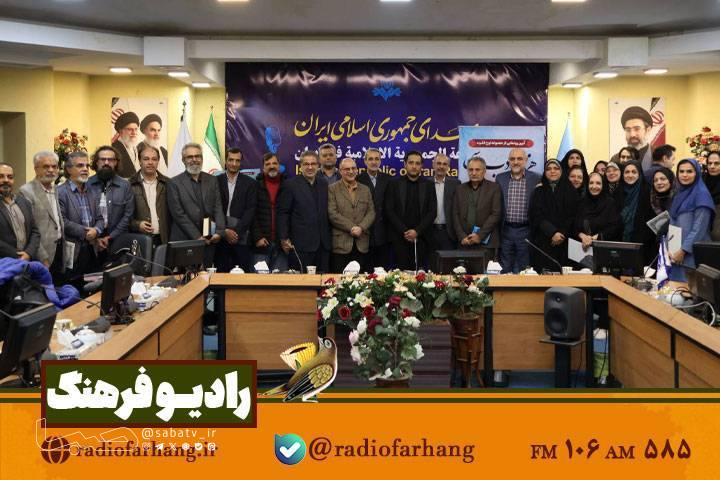


The unveiling ceremony of the CD collection of 1,200 episodes of the “Hazareh Adab Parsi” radio program and the obituary of the late teacher Behrouz Razavi was held in the Shahadai Building of the Voice Vice-Chancellor by Farhang Radio Network.

According to Saba, The unveiling ceremony of the 1,200-episode CD collection of the “Hazareh Adab Persian” radio program and the obituary of the late master Behrouz Razavi was held (Tuesday, November 19) in the presence of Dr. Ahmed Pahlavanian, deputy voice officer, a group of parliamentarians, senior managers of the national media, prominent professors and researchers of Persian language and literature, veterans, program staff and the family of this well-known artist, in the Shahada building of the voice vice-chancellor, by the Farhang radio network. An event in which the practical protection of the Persian language as the identity border of the land of Iran and the continuation of the production of great listening works were emphasized.
In this ceremony, Dr. Ahmed Pahlavanian, Vice President of Sound, emphasized the necessity of protecting the Persian language, considered this language to be a part of the identity and sacred heritage of Iranians, and referring to the breadth and richness of the country’s cultural and literary heritage, he said: One of our professors in the master’s course in communication always uses the expression that “we are like a snake sleeping on a treasure”; A treasure that is nothing but our cultural and civilizational heritage. No matter how hard we try to take advantage of this treasure, represent and introduce it in radio and other media, the result of the work is like a drop in the sea compared to the greatness of this heritage. This treasure is so deep, wide and limitless that it is beyond our ability to represent and fully exploit its capacities.
Emphasizing that the Persian literary heritage should not be considered only as a collection of artistic and literary works, the vice president of Sada added: This heritage is an intellectual and epistemological system and an ocean of thought. Because its creators were great, sages and thinkers such as Hakim Abulqasem Ferdowsi, Hakim Nizami, Hakim Sanai, Hafiz and Saadi. Hafez himself was a great jurist and an outstanding commentator, and Saadi was also considered to be a world-viewing scholar, jurist, theologian, and thinker in addition to his literary status. Despite their intellectual differences and characteristics, these elders have created a treasure whose introduction is actually the introduction of a wide part of the thought, culture, civilization and intellectual heritage of humanity.
Referring to the geographical and historical scope of the Persian language, Pahlavanian stated: In few parts of the world, such a volume and scope of intellectual exchange and literary productions can be observed in one civilization area. During my travels and stays in different parts of Iran’s cultural sphere, I have been closely acquainted with the vastness, roots and greatness of the Persian language. The national media and especially Radio Farhang should play a more effective role in introducing and promoting this heritage by using their capacities.
He went on to openly criticize the prevalence of foreign words in the media and pointed out: unfortunately, in a media that wants and should be the flag bearer of the revival of Persian literature, one of our most important problems is the widespread use of foreign words. It is a regrettable issue that should be seriously considered and corrected. Just as the flag of the Islamic Republic of Iran, the national anthem, the Persian Gulf and geographical borders are sacred and respected for us, our cultural and linguistic borders also have the same sanctity and respect. Ferdowsi’s Shahnameh, the works of Hafez and Rumi, and the Persian language are all parts of this historical identity, and the Persian language should be embraced and kissed.
In the continuation of the ceremony, Dr. Mohsen Habibi, director of the Farhang radio network, emphasized the inseparable link between national identity and the media, and said: Paying respect to Behrooz Razavi is not only honoring an announcer, but honoring the integrity of radio art, national identity, and protecting the privacy of the Persian language. The collection of 1,200 episodes of Hazare Adab Parsi is a proof of the claim that radio has always been and will be a strong bastion of protection of the noble and original texts of Iranian culture.
Dr. Mahmoud Shalawi, head of the Association of Cultural Artifacts and Honorable Mentions and Advisor to the Minister of Culture and Islamic Guidance, also emphasized the need to recognize and respect elders and added: “The honorees and elders of this country are our unique assets and should be appreciated and placed at the top during their lifetime. Master Razavi put his words and his soul in the service of the wisdom of Persian literature, and the resonance of his voice made every great work eternal in the heart of the audience.
Dr. Mohammad Jaafar Mohammadzadeh, a literary researcher and veteran media manager, analyzed the relationship between language and literature and the history of a nation and said: Persian literature is the living birth certificate and living historical memory of the Iranian nation. The official history may change during the rise and fall of governments, but what guarantees the survival and continuity of a civilization is the very essence of literature, which the radio has recreated by producing lasting works such as the Millennium of Persian Literature.
Dr. Abbas Moqtadaei, the representative of the people of Isfahan and the vice-chairman of the National Security Commission of the Islamic Council, while praising the media position of Professor Razavi, stated: Behrouz Razavi’s greatness was so obvious that even during his lifetime, his honor and closeness was recognized. The Millennium Program of Persian Literature should not be just a programming line, but should become an identity highway to transfer the history and civilization of 11 thousand and 500 years of Iran and connect the prides of the entire civilization field of cultural Iran, from Balkh to the farthest parts of this land, to the new generation.
Ali Ilant, the representative of the Council for the Protection of the Persian Language in the Ministry of Culture and Islamic Guidance, also pointed to the challenges facing the national script and language and said: In the age of the development of technologies, artificial intelligence tools and media attacks, the Persian language is exposed to new challenges. The production of original and documented works such as Hazare Adab Parsi is the frontline of sustainability and protection of our vocabulary and linguistic originality in today’s fast-paced environment.
In the continuation of this ceremony, it was the turn of colleagues and agents of “Hazareh Adeb Parsi” collection; Farhang Joulii, a veteran radio producer, recalled more than two decades of continuous cooperation and five decades of friendship with Behrooz Razavi and said: I lived and worked with Behrooz on a daily basis for more than 20 years in radio and television. His presence gives awe, authenticity and credibility to any text, and every manager and official surrenders to his eloquent and dominant expression. The void of his noble tone and calm and dignified personality will be felt in the studios forever.
Mohammad Baqer Rezaei, the writer, editor and veteran researcher of this collection, referring to the work commitment and moral qualities of Ustad Razavi, noted: During the years of cooperation, I compiled deep questions about various aspects of Ustad Razavi’s life and art, which he handed over in manuscript every week. The result of this work is 60 pages of valuable and untold manuscript that even those closest to him are unaware of and I hope it will be published soon. He was a person far from any ego and always said, “Just call me Behrouz.”
Then the speakers of this work spoke; Maryam Vaezpour, a long-time radio announcer, pointed to her sense of belonging to this work and said: In my 39-year career as a presenter, performing parts of the series “Hazareh Adeb Parsi” was the peak of my artistic pleasure, and I have never felt such peace and fertility in any work. The production of such a collection is the result of the collective wisdom and unparalleled research efforts of Professor Rezaei and the producer of the work, and it is our duty to cherish our veterans as long as they are with us.
Fatemeh Rukni, another well-known radio announcer, described the implementation of this program as a human-building school and said: “Millennium collection of Persian literature is a school of love, knowledge and literature.” Being with Professor Behrouz Razavi was a lesson in discipline, patience and respect for the mother tongue for every speaker, and his humble guidance is always in our ears.
Narges Isfahani, one of the presenters of the radio and this series, added in a literary statement: “Millennium of Persian Literature” was a heartwarming journey and a direct invitation to the depth of Iran’s ancient civilization, wisdom and knowledge. The heavenly voice and unique resonance of Behrouz Razavi was like a mirror that connected the flourishing aspects of poetry and literature of our ancestors to the audience.
Reza Khazarai, the veteran radio announcer who took over the narration of this work after the death of Master Razavi, said: I will never call Behrooz Razavi “alive” because he is eternal for me and the people of a living culture. After visiting him and with his direct permission, I continued the narration of this treasure from number 1001. So far, the recording of the work has reached more than 1,260 numbers, and after passing through the poets of the 7th and 8th centuries, such as Obeid Zakani, Ibn Yamin and Salman Savji, the caravan of the program reaches the threshold of Hazrat Hafez’s court.
Mohammad Hosseini Baghsangani, the producer of the collection “Hazareh Adeb Parsi”, also paid tribute to the round-the-clock efforts of the author and the production team and said: This collection was created with the great efforts of Professor Mohammad Baqer Rezaei and based on reliable historical documents. We are the continuation of the path that Ferdowsi opened for us; “I don’t think that I am alive / that I spread the word”. Professor Behrouz Razavi read these texts with his life and these 1,200 parts are an audible, stable and honorable document for the history of Iranian literature and voice acting.
During this ceremony, audio parts of Behrouz Razavi’s lasting performances and poetry readings were played, which created an atmosphere full of nostalgia and regret for the loss of this artist. Also, the broadcast of a video of the message and words of Dr. Jale Amoozgar, a prominent linguist and mythologist, about the value of protecting identity treasures and the authenticity of ancient Iranian language and literature, attracted the attention of those present.
In the final part, in the presence of Dr. Ahmed Pahlavanian, Dr. Mohsen Habibi, Dr. Abbas Moqtadaei, Dr. Mahmoud Shalawi, Dr. Mohammad Jaafar Mohammadzadeh, and Professor Farhang Jaulii, the commemorative CD of 1,200 episodes of the radio collection “Hazareh Adeb Parsi” was unveiled and the exquisite commemorative panel of this ritual was presented to Raman Razavinia, the son of Behrooz Razavi, in recognition of his father’s years of brilliance. Raman Razvinia also expressed his gratitude to the people of the radio, emphasizing the preservation of the spiritual privacy of his father’s works and rejected the simulation of the late speaker’s voice by artificial means due to the richness of his works left in the media archive.