





According to the news agency Online news Quoting Faradid; The aqueduct of the town of Gonabad was built with a 300-meter mother well and 2500 years old, with the initiative of step wells and multi-stage elevators without pumps.
You are standing nearly 300 meters below the ground in total darkness. Above your head is only the narrow opening of the well through which the sunlight barely passes. You are surrounded by dirt and stones, and every pickaxe blow separates another piece of the wall. Somewhere up there, a few people are waiting to pull up the dirt bucket with a rope so you can continue digging.
Now imagine this happening not with modern mining equipment, but with simple tools and human hand power; That too thousands of years ago.
In Gonabad, a city in the south of Razavi Khorasan, there is an underground network that turns such an image from a fantasy into an engineering reality. The aqueduct of the town of Gonabad, a structure with roots of about 2,500 years, is one of the most amazing examples of water engineering in ancient Iran; A series of tunnels and vertical wells that led water from the depths of the earth to the settlements without the need for a pump.
But what makes Qasba aqueduct spectacular is not only its age. The bigger question is how the people of that time were able to build such a network in the heart of the earth.
According to a research published in Land magazine, the total length of Qasbah aqueduct network is about 33 kilometers and the depth of one of its mother wells is nearly 300 meters. Of course, these figures are related to the whole collection and its different branches; Not a straight tunnel that was dug all in one historical phase.
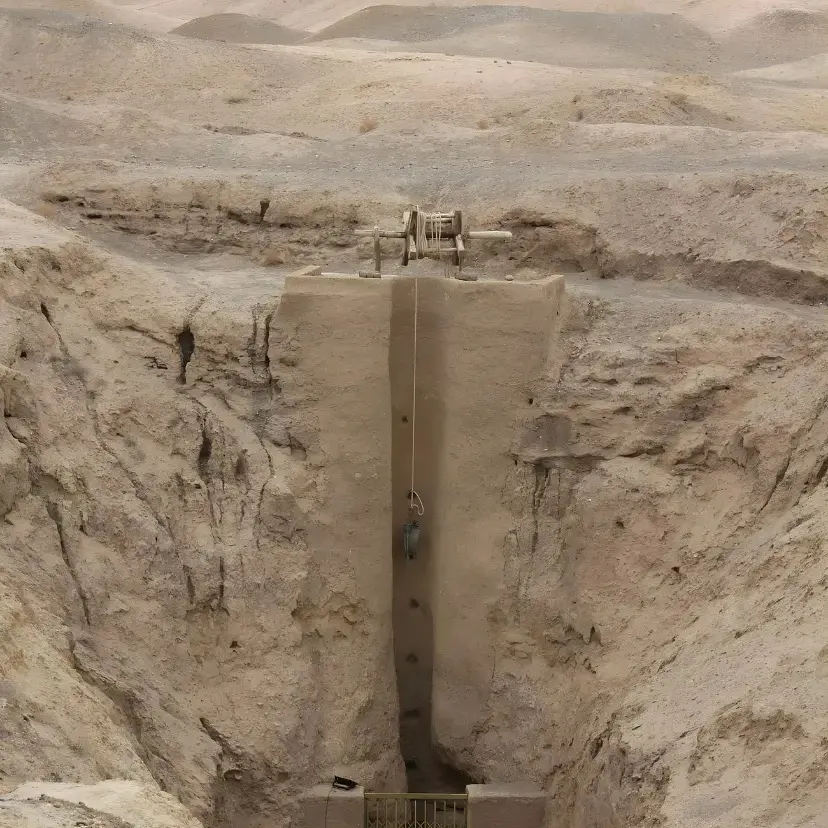
To understand the magnitude of these numbers, just think about the height of a hundred-story building. The deepest part of the aqueduct has almost this distance from the surface of the earth; with the difference that instead of going up, its builders had to go down hundreds of meters in the heart of soil and stone.
At first glance, it may seem impossible to dig such a well with only human power. But Iranian authors found solutions for the most difficult part of the story, which are still interesting to study.
The main problem was not just digging the ground. Each stroke of the pick produced new soil and stone that had to be removed from the excavation site. In shallow wells, this was done with a bucket, a rope and a wooden wheel. But when the depth of the well reached hundreds of meters, this simple method became a big problem.
The rope that had to go down to a depth of 300 meters had a considerable weight. Moisture could add weight to the cotton ropes and increase the strain on the hoist wheel. Now add the weight of the bucket full of soil to it. Lifting such a load required a lot of strength.
In the specialized book Qanat Knowledge: Construction and Maintenance, written by Ali Asghar Samsar Yazdi and Majid Labaf Khaniki, it is explained that the weight of the rope needed for a 300-meter well could reach at least 150 kg; The weight is several times that of a normal bucket of soil.
To solve this problem, the engineers came up with a solution that is reminiscent of the intermediate elevator stations in today’s high-rise buildings.
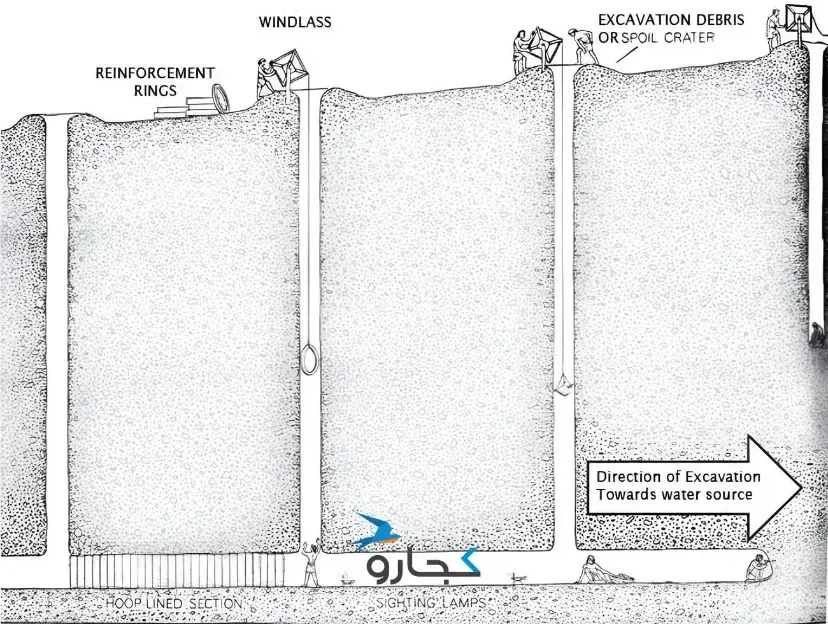
Instead of a bucket of dirt going up the entire path at once, the path could be divided into several shorter sections. In the depth of the well, spaces were considered for the placement of workers and the installation of lifting wheels. The dirt bucket was brought up from the lowest part, connected to the next lifting rope at the middle station and finally reached the ground level.
In the description of traditional aqueduct construction methods, it is mentioned to create such stations at distances of about 80 to 100 meters.
Regarding the exact form of implementation of this idea in Qasba aqueduct, two reconstructions have been proposed. In one of them, the drilling path was divided into several vertical wells that were connected to each other by a short horizontal shift; What is called a step well. In the other reconstruction, the deeper well has a continuous structure, but along its path there are stations for staged soil transfer.
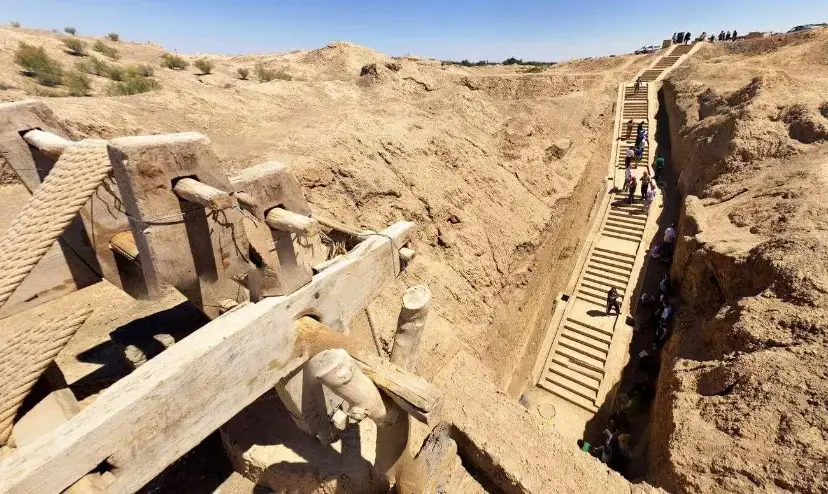
In both cases, the essence of the story was the same: to break down a nearly impossible operation into several smaller, more manageable operations.
These details may seem simple today, but at the time, each intermediate station meant a space that had to be dug by hand and strong enough to accommodate the worker and the lifting equipment.
Even lifting the dirt bucket was not without danger. A stone falling from the wall or a rope breaking could kill someone who was working dozens of meters below. For this reason, aqueduct construction was not only dependent on physical strength; Experience, knowledge of the soil and adherence to traditional safety practices were also vitally important.
But even if the problem of getting the dirt out was solved, another danger still lingered in the darkness of the tunnel: air.
In a closed underground space, especially where there was insufficient ventilation or where gases collected in the ground, breathing could become difficult and even dangerous. Miners needed breathable air to work deep underground and could not always rely on random air flow. One of the important functions of the vertical wells, which were dug at different distances along the aqueduct, was tunnel ventilation.
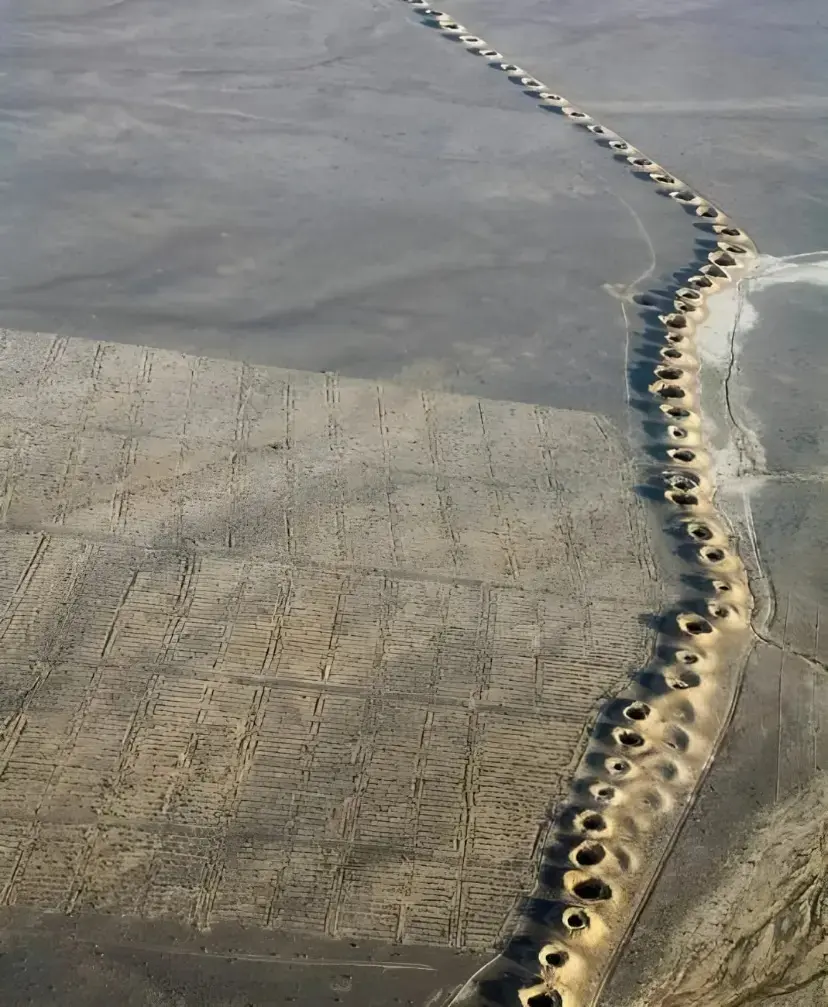
If we look at the path of an aqueduct from above, we usually see a row of well openings that are placed on the ground like dots one after the other. These wells were the way to access the tunnel, the soil from digging was pulled out through them and they also provided the possibility of connecting the underground space with the open air.
The pressure difference caused by the wind and the air temperature difference could cause the natural movement of air between the wells and the tunnel under the right conditions. However, such a flow was not always sufficient, especially when the drilling site was far from the nearest well. Maghni had a solution for this problem as well.
Samsar Yazdi and Labaf Khaniki, in the chapter related to the problems and limitations of aqueduct excavation, describe the methods in which air was transported to the end of the tunnel with the help of special ducts or hand tools.
One of these methods was the use of a hand hammer, similar to a blacksmith’s hammer. This device was placed next to the mouth of the well and brings fresh air through a cloth tube to the place of activity of the magni. In another way, they used the space above the tunnel reinforcement covers to direct the air.
These explanations are related to the knowledge and traditional methods of making aqueducts, and it does not necessarily mean that all these tools were used in the first period of construction of Qasbah aqueducts. However, they show that the Iranian speakers were aware of the ventilation issue and had found practical solutions for it.
When we look at the set of these measures, the picture of aqueduct construction changes completely. We are no longer dealing with a few people who are simply doing the ground work. Behind every meter of tunnel progress, there was a set of technical decisions; From the location of drilling the next well and the strength of the walls to the transfer of soil, delivery of air and protection of workers’ lives.
However, the biggest engineering puzzle of Qasba aqueduct still remained.
How can you dig tunnels several kilometers long underground and be sure that the water will move all the way, without using any pumps? The answer lies in one of nature’s simplest forces: gravity.
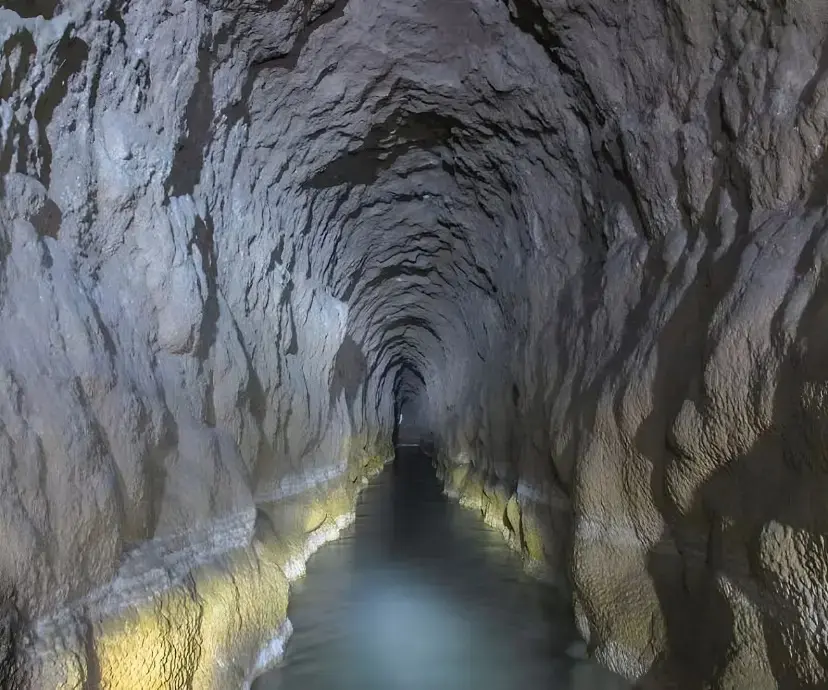
Unlike a well from which water is drawn up by human power or a machine, an aqueduct relies on the difference in height to transport water. The route starts from the parts where the underground water table is at a higher altitude. Water enters the tunnel from the aquifers and slowly moves to the lower lands due to the gentle slope of the path.
But this simple explanation hides one of the most difficult parts of the job.
If the slope of the tunnel is too low, the movement of water will be difficult and the possibility of sedimentation will increase. If the slope is too steep, faster water flow can erode the bed and damage the structure. The speakers had to create a balance between these two situations; That too in a place where it was not possible to see the entire route from the beginning to the end.
For this reason, the precise determination of the height, direction and slope of the tunnel was essential. Aqueduct craftsmen used traditional methods of measuring and leveling the path; The knowledge that was passed down from master to student over generations.
As UNESCO points out in explaining the global value of the Iranian aqueduct, water transfer in these systems was based on the gentle slope of the tunnel and the force of gravity. In addition to removing soil and ventilation, vertical wells also provided access for track maintenance and repair.
Choosing the underground route had another advantage. In a land where the sun and heat can evaporate a significant part of the surface water, the passage of water underground helped to reduce its contact with the direct heat of the sun.
In fact, the aqueduct was not just a water transfer tunnel. It was a system that was designed by knowing the earth, taking advantage of gravity and adapting to the dry climate.
The wonder of the Qasbah aqueduct was so great that even hundreds of years after its formation, travelers were amazed to hear its stories.
In his travelogue, when narrating the journey on the way to Gonabad, Nasser Khosro tells a story about a man who was sent to get a trapped person into the Kariz well. In this narration, it is mentioned about a rope seven hundred yards long and a big water stream in the depths of the earth.
This story cannot be considered a detailed engineering measurement report, but it has an important point from a historical point of view: nearly a thousand years ago, the depth and greatness of Gonabad’s Kariz was so incredible for people that it became the subject of amazing narratives.
Even in some local beliefs, the construction of this kariz was attributed to Ki Khosro, the mythical king of Iran. It was difficult for people to imagine that ordinary people could build such a structure in the heart of the earth.
Today, we know that what was once attributed to mythical creatures was the result of the knowledge and efforts of successive generations of humans.
Qanat Kasbah, like many historical structures, is not the product of a moment or a generation. Its various parts have been dug, expanded, repaired and dredged throughout history. The oldest parts of the complex go back to ancient Iran, but the network we know today is the result of centuries of work and maintenance.
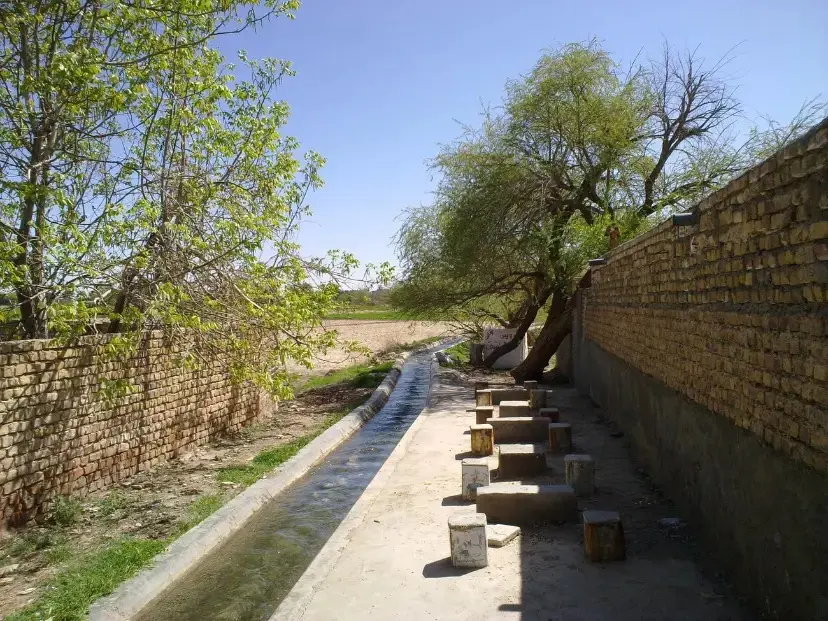
The importance of the aqueduct is not only in its underground tunnels; It is water that has made life possible in dry lands for centuries.
The importance of this world record was not only related to the age or the astonishing dimensions of the structure. When recorded, these aqueducts still maintained their water supply function and were part of a living tradition in water management.
Of course, the survival of an aqueduct does not guarantee its future. A research in 2026 about the dangers of the Kasbah aqueduct shows that climate change, over-harvesting of underground water, urban development and the forgetting of traditional knowledge are important threats facing this heritage.
Perhaps this point turns the story of the Qasba aqueduct from a historical wonder into a contemporary issue.
When we talk about advanced engineering, we usually think of huge drilling machines, computers, and sophisticated technology. But in Gonabad, thousands of years ago, humans with much simpler tools approached a problem that still matters today: how to get water from where it is to where life depends on it?
They had to make a way through the rock, bring the soil up from the depths of the earth, bring air to the work site and build tunnels with a height difference sufficient for the movement of water. Success at each stage was the result of a series of experiences, tests and accurate knowledge of nature.
The aqueduct of the town of Gonabad can perhaps be seen as a reminder of a simple truth: engineering does not always mean overcoming nature; Sometimes the greatest feat of engineering is knowing nature well enough to cooperate with it.
And maybe the next time we see clear water in a small stream, it’s not bad to think that in the past, to bring this same water to the surface of the earth, people were working hundreds of meters under the feet of others, in darkness and silence.
259



