





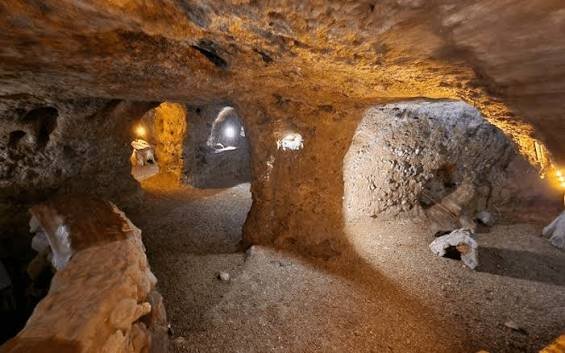
According to the news agency Online news According to Asr Iran – Hassan Zahouri: In Kurd Alia village of Tiran and Koron counties in Isfahan province, there is a collection of hand-me-downs underground, which is known as an underground city. A complex and nested space, many of its secrets are still unknown.
The entrance to one of the paths of this collection is hidden behind the green door of an old school; A school that no longer has much educational use; But this is only one of the ways in and out of the shelter spread deep underground.
Upon entering the basement, after going down some stairs, we reach a square-like space. Around this square, several paths and altars can be seen and three ways are placed in front of the visitor; Paths that each lead to different parts of this collection.
Ali Safari, head of the Kurd Alia Islamic Council and the trustee of this underground shelter, says that this complex has about 80 entrances, next to each of which, a water well and an altar can be seen on the right side. He believes that placing the altar on the right side of the entrances is related to the place of the sacred in ancient architecture.
The first path is the shortest path in this series. However, on this route there are also large rooms with platforms for sitting around them. The path finally ends in a large hall; A space whose exact use is not yet known. On the walls, the traces of digging tools, including axes, hammers and picks, can be clearly seen.
The second path also leads to a dead end, but it contains different spaces. In one of the sections, another entrance can be seen that has not been emptied yet and its water well is also on the right side. According to Safari, the architecture of this part is designed in the form of holes and irregularly and is modeled after the structure of a mouse colony or nest.
Further along the path, a large hall with platforms on both sides can be seen. At the end of the hall, there is a space similar to a special individual sitting position. The large rooms and numerous corridors of this complex raise many questions about its main use.
Safari believes that the multiplicity of entrances and the structure of these spaces are designed with the aim of maintaining silence and concentration of people. According to him, this complex was used as a temple or shrine in ancient times, including the Achaemenid period.
Around 2015, a group of archaeologists and researchers visited this collection and introduced it. Safari says that his information and impressions about the architecture and history of this shelter are the result of his meetings and conversations with the same researchers.
According to the information provided about this complex, its area is about 20,000 square meters and parts of it are located approximately 10 to 12 meters deep. It is considered to be about 2 thousand years old and belongs to the Parthian and Sasanian periods; However, some views attribute the beginning of its formation to the Achaemenid period.
About 80 hidden entrances and exits connect this complex to the ground level. Tunnels, winding corridors, numerous rooms and halls have created an irregular yet interconnected structure. It is said that this complex has two or three floors that are connected to each other by stairs.
The third path, unlike the previous two paths, is not a dead end and leads to other parts of the basement. Archaeologists have assumed that this complex had the capacity to accommodate about 3 thousand people; A population that may be mostly made up of warriors or local residents. The complex structure and multiple entrances could also make it difficult for the enemy to enter it.
One of the remarkable points in the architecture of this complex is the air conditioning method. Safari believes that some holes that may look like ventilation at first glance, are actually secret and partisan entrances belonging to the Parthian period. According to him, the air circulation in these spaces is done through the level difference and many stairs.
But the history of this basement is not limited to ancient periods. According to local narratives, from the Safavid period onwards, Armenians came to this village and gradually became its main residents. Before that, the village was called Gord; A word that means brave men.
Armenians living in this area were mainly cattle farmers and had their own religious rituals. Gradually, these underground spaces became a place to spend hard winters and keep herds. Some archaeologists have also suggested that these nested spaces were used for Christian religious ceremonies.
In other parts of the collection, Safari refers to pyramidal columns; Columns that, contrary to the common idea of architectural columns, have large dimensions and their structure is in the form of a pyramid. He considers this feature as another evidence that can help to understand the architecture and age of the complex.
Safari also shows entries that he believes belong to the Achaemenid period. In one of these sections, stones can be seen that are placed on top of each other without using mortar. Referring to the arrangement and slope of the stones, he attributes this architecture to the Achaemenid period and distinguishes it from Parthian and Sasanian examples.
Next, we reach a path that leads to another part of the complex. The height of this tunnel is about one meter and 60 centimeters. Safari believes that the low height of the underground spaces, in addition to architectural considerations, was related to their religious use and people had to bow their heads when entering these places.
One of the stairs at the end of the fifth path leads us to another part of the Upper Kurd village. All this way, one question has occupied our mind: Where was the soil obtained from digging so many tunnels and underground rooms dumped?
The answer is zero on a hill opposite the exit of the complex. He says that this hill is the result of the soil that came out of the earth when digging underground spaces; According to him, the soil was transferred from the starting point of the construction of the complex.
Our underground journey returns to the same old school; where there are some tombstones belonging to Armenians left in its yard. One of these stones is about 500 years old and belongs to a person named Sahak Simoni. Another tombstone can be seen in a corner of the yard that belongs to a couple; A couple who apparently built their joint tombstone before death so that a sign of their bond would remain even after death.
Upper Kurdish underground shelter is now registered in Iran’s national heritage list; An amazing collection that, despite the years since its introduction, there are still many questions about its construction history, architecture and usage. Perhaps the national registration of this work is the beginning of a way for archaeologists and researchers to be more serious; A way that can reveal the secrets of one of the most unknown underground spaces of Iran.
259



