





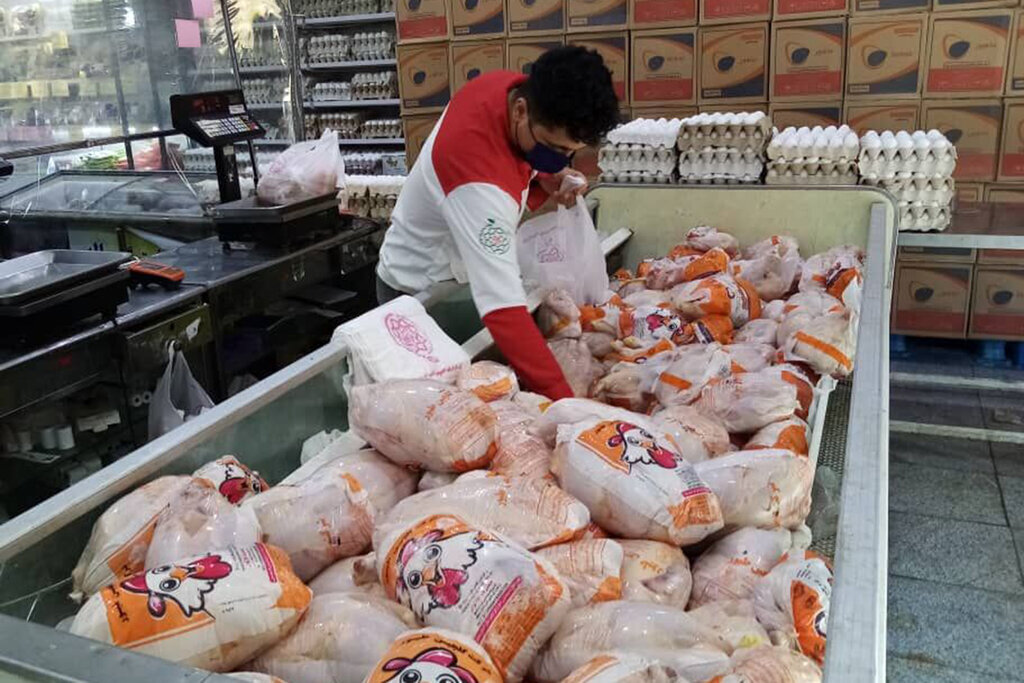
According to Khabaronline news agency, in addition to the increase in the price of chicken for consumers, poultry farmers also talk about the growth of input costs, lack of liquidity and unprofitable production. This is despite the fact that meat production increased by 9% in September. Statistics that raise this question once again, why the increase in production could not lead to price stability and improve people’s access?
Ekhtaz Online wrote: For years, chicken has been one of the main sources of protein supply in the food basket of Iranian households, a product that, due to its lower price than red meat, has made a significant contribution to the people’s table. However, the increase in the cost of living and the growth of food prices have made the purchase of this product a financial issue for some households.
Field surveys of some chicken supply centers in the western and central areas of Tehran show that each kilogram of freshly slaughtered whole chicken is sold at a price of 380 to 450 thousand Tomans. Also, the price of premium boneless chicken breast is 698 thousand tomans, boneless and skinless chicken breast is 614 thousand 500 tomans, premium chicken thigh is 480 thousand tomans and chicken thigh is 326 thousand 500 tomans, the price of hot chicken fillet is 550 thousand tomans per kilogram.
With this account, buying two kilograms of whole chicken at the observed rates costs between 760 and 900 thousand tomans; A figure that can account for a significant part of the food budget of households with a fixed income. Of course, the price of packaged products and different parts of chicken is different according to the quality, weight, type of packaging and the place of supply.
What is the share of distribution circles?
One of the ambiguities of the chicken market is the gap between the announced rates and the prices that consumers see in some stores and supply centers.
According to the report that was published on 28th of October, the price of each kilogram of hot chicken was increased from 250 thousand tomans to 320 thousand tomans with the permission of the Ministry of Jihad and Agriculture. In the same report, the observed prices in the market were announced between 260 and 340 thousand Tomans.
Comparing these figures with the prices observed in some supply centers indicates the existence of a significant difference in the sale rate of chicken. Although the difference in quality, transportation cost, type of packaging and supply location can explain part of this difference, the contribution of slaughterhouses, packaging units, distribution network and retail stores in the final price still needs to be investigated.
In such a situation, the question arises why, despite the increase in the price paid by consumers, some producers still report that their activities are unprofitable? The answer to this problem should be sought in the real production costs, the selling price at different stages of the chain and the share of each part of the final price.
Increase in the cost of inputs and liquidity pressure on poultry farmers
While consumers are facing an increase in the price of chicken, producers are also talking about the growth of the cost of inputs and the increase in the need for working capital; Conditions that have made it more difficult to continue the economic activity of production units.
In the same context, Akbar Fathi – Vice President of Planning and Economic Affairs of the Ministry of Agricultural Jihad – on October 26, referring to the Ministry’s plans to improve production conditions, announced: Improving productivity and improving the quality of inputs and livestock and poultry feed can reduce production costs and reduce the distance between the prices of products from production to consumption.
He mentioned the direct supply of products and shortening the distribution path as other solutions to reduce the gap between the price received by the producer and the amount paid by the consumer and announced the follow-up of financing programs with the participation of Bank of Agriculture, Bank of Tejarat and production organizations.
In another statement, referring to the consequences of the exchange rate liberalization, Fathi said: the livestock and poultry industry’s need for working capital has increased at least four times after the implementation of this policy; A problem that has turned the provision of liquidity needed by producers into one of the basic challenges of this industry.
The Deputy Minister of Jihad Agriculture also stressed the inadequacy of the traditional methods of bank financing, using the capacity of the capital market, chain financing and the participation of other banks as necessary to support production.
On the 1st of November, he also emphasized on timely provision of inputs, increasing productivity, reforming market regulation policies and avoiding mandatory pricing, and considered increasing the predictability of market conditions as one of the requirements for production stability.
Poultry farmers say about the loss, consumers are facing high prices
In addition to the statements of the officials of the Ministry of Agricultural Jihad, the activists of the poultry industry also report the increase in production costs and the disproportion of the selling price with the total cost.
Habib Asadollahnejad, CEO of the Nationwide Association of Meat Poultry Farmers of the country, announced in the statement published in October: The cost price of each kilogram of live chicken for the producer is about 250 thousand Tomans, while the chicken farmers have sold their product for between 160 and 180 thousand Tomans per kilogram.
He also announced the increase in the price of inputs and said: the price of each kilogram of corn in the market system has reached 69 thousand tomans and the price of soybean meal has reached more than 100 thousand tomans; While these figures were about 43,000 and 70,000 tomans, respectively, before the correction of the exchange rate.
Of course, these figures are related to the situation announced at the same stage, and comparing them with the price of slaughtered chicken or packaged parts in retail stores, regardless of the difference in the stages of the production and distribution chain, does not provide an accurate picture of the amount of profit or loss of each sector.
However, the juxtaposition of reports related to the losses of poultry farmers and the high prices paid by consumers increases the need to clarify the mechanism of price transmission in the chain of production to consumption; Especially, it is not clear what share of the final price of the product is allocated to the cost of production and how much is allocated to the costs of slaughter, packaging, transportation and distribution.
The increase in production did not prevent the price of chicken
The noteworthy point in examining the chicken market situation is that the increase in the price of this product cannot be explained simply by the lack of production at all times.
According to the report of the Iranian Statistics Center, which was published on October 26, the production of poultry meat in official slaughterhouses reached 243,866 tons in September 1405, which shows a 9% increase compared to the same period last year. Of this amount, about 237,722 tons were related to chicken meat.
This statistic shows that the registered production of poultry meat in official slaughterhouses has increased; However, production growth alone cannot explain the price situation. The cost of inputs, slaughter and packaging, transportation, distribution conditions and effective demand are also factors affecting the final price.
On the other hand, reducing the purchasing power of households can reduce the effective demand for chicken; This means that despite the need for food, some consumers cannot afford to buy the amount they need. In such a situation, increasing production does not necessarily mean improving the access of all households to this product.
The necessity of coordinating production and consumer protection policies
What is observed in the chicken market today is a problem beyond the increase in the price of an edible product. On the one hand, there are households who are forced to limit the purchase of protein products due to the growth of living costs, and on the other hand, there are producers whose economic activity has been made difficult by the increase in input prices, lack of liquidity and market volatility.
In such a situation, careful examination of production and distribution costs, price clarification in different links of the chain, timely provision of inputs and shortening the distribution path can help to reduce some of the market inconsistencies. In addition to these measures, it is also necessary to pay attention to the purchasing power of households; Because the access to needed food is not only dependent on the amount of production and the economic power of the consumer also plays a decisive role in it.
It seems that overcoming the current state of the chicken market requires policies that pursue two goals at the same time: providing suitable economic conditions for the continuation of production and providing the possibility of purchasing protein products at a price commensurate with the purchasing power of households. Otherwise, even the increase in production alone cannot guarantee people’s sustainable access to this basic commodity.
223225