





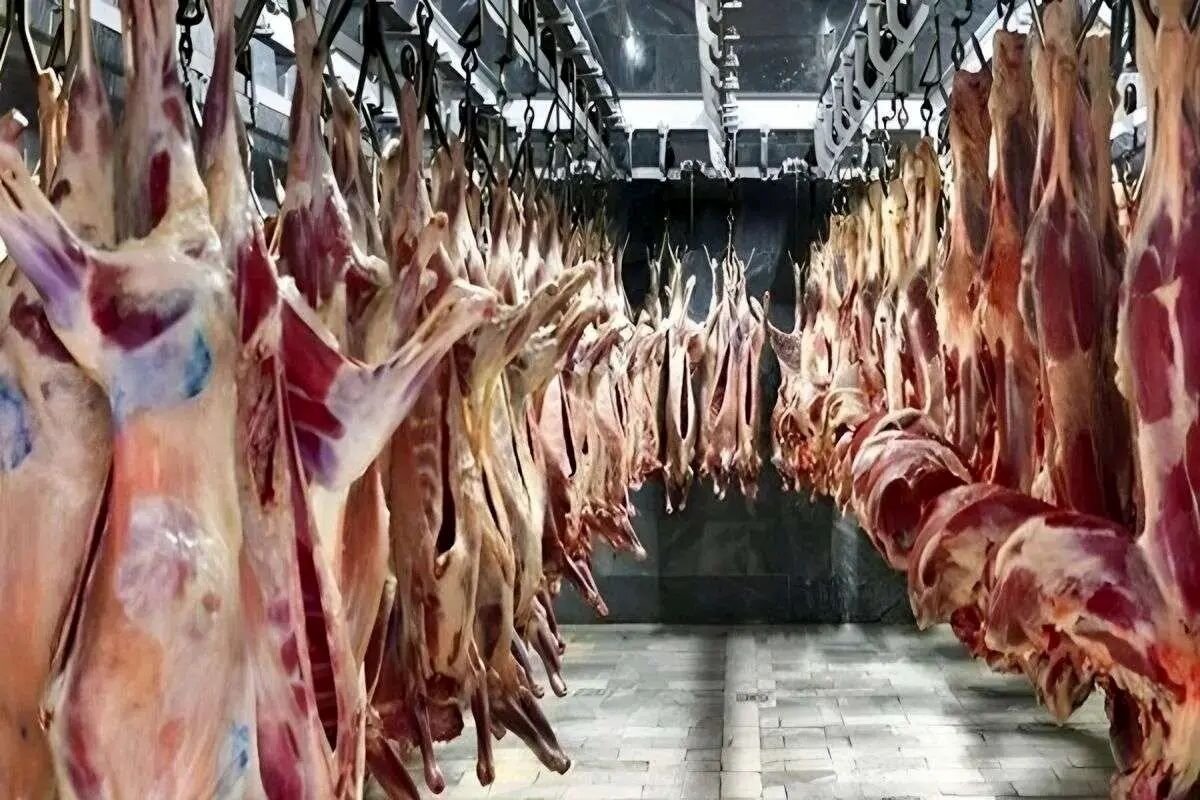
According to Khabaronline news agency, red meat as one of the important sources of protein supply in the household food basket is available in the market at different prices these days; In such a way that the price of some pieces of mutton and veal has exceeded two million tomans and even reached about two million and 600 thousand tomans. At the same time, livestock activists report the relative stability of live livestock prices and the improvement of the production situation in the country; An issue that has once again raised questions about the factors affecting the final price of meat and the distance between the livestock market and the consumption market.
ISNA wrote: According to field observations from one of the meat sales centers in the Azadi area (November 10), each kilogram of sheep muscle costs 2 million 150 thousand tomans, mutton with bone costs 2 million 250 thousand tomans, and mutton thigh costs 2 million 340 thousand tomans. Also, each kilogram of sheep offal is sold at 1 million tomans and 1 million and 100 thousand tomans of minced mutton.
In the veal sector, the prices are also different; So that each kilogram of calf thigh is priced at two million and 600 thousand tomans, premium thigh marrow at two million and 340 thousand tomans, premium head at two million and 340 thousand tomans, and premium muscle at two million and 476 thousand tomans. Also, each kilogram of premium beef mince is sold at a price of one million and 520 thousand tomans. Comparing the prices of different parts shows that the choice of meat has a significant impact on household expenses. For example, buying a kilogram of calf thigh costs two million and 600 thousand tomans, while the price of one kilogram of premium minced beef is one million and 520 thousand tomans. That means a difference of more than one million tomans per kilogram.
The relative stability of the livestock market against high meat prices
In this regard, Mansour Pourian, the head of the country’s Livestock Supply Council, said about the latest situation of production, supply and price of live livestock: the livestock market has been relatively stable in the autumn season and the production conditions in the light and heavy livestock sector, both in the field of slaughter and productive livestock, are considered favorable. Also, autumn births, especially in the light livestock sector, have a good trend that can help maintain and strengthen the country’s livestock population. The increase in the price of meat in the past months, especially in the summer and under the influence of war conditions and market fluctuations, increased the willingness of livestock farmers to work in the fattening sector. Based on this, many livestock farmers and fatteners moved towards keeping and fattening semi-meat animals, low-weight animals and some female animals, which resulted in a significant growth of fattening activities compared to last year.
Pourian continued: A significant part of the livestock that entered the fattening cycle in the past months will reach the appropriate slaughter weight in the winter season. Therefore, it is expected that in the coming months, we will face an increase in the supply of breeding livestock and a suitable amount of domestic meat production.
Referring to the state of heavy livestock, the head of the country’s Livestock Supply Council stated: The conditions of calf fattening have also improved compared to last year, and a good growth has been recorded in foreign breeds such as Holstein and Simmental, as well as crossbred and indigenous calves.
Increasing the attention of ranchers to buffalo breeding
Emphasizing the increasing attention of producers to buffalo breeding, he said: One of the positive changes in the heavy livestock sector is the increase in the willingness of ranchers to breed this animal. Due to the increase in production costs and the difference in the cost of feeding buffalo with some breeds of cattle, this animal has become one of the most popular options for ranchers. Better access to some inputs needed by buffaloes inside the country, as well as the increase in demand for the milk of this animal in the dairy industry, especially ice cream and butter production units, has caused the population of productive buffaloes to increase. At present, domestic buffalo meat has also found a certain share in the country’s meat supply basket, and the development of breeding of this animal can help compensate for some of the discrepancies in meat production in the calf sector.
Referring to the importance of maintaining the productive livestock population, the head of the country’s Livestock Supply Council stated: Preserving productive livestock, whether in the light or heavy livestock sector, is very important; Because the continuation of production and the increase of supply capacity in the future depends on this population. Last week, the livestock market faced some limited and temporary price increases in different regions, but these fluctuations were not widespread and the prices returned to the previous range.
What is the price of live livestock?
The head of the country’s Livestock Supply Council said about the price of live animals: Currently, the price of each kilogram of heavy slaughter male lamb is in the range of 690 to 720 thousand tomans. Also, the price of female lamb is about 700 thousand tomans and semi-meat lambs are in the range of 680 thousand tomans. The price of other light livestock groups such as sheep, goats and goats in some categories is around 500 to 520 thousand tomans. In general, the light livestock market is in a relatively stable condition, and in some groups of slaughter livestock, even a price reduction has been observed.
Pourian also said about the situation of heavy livestock: the price of live cattle is between 520 and 570 thousand tomans and the price of buffalo is between 500 and 610 thousand tomans. The prices of some groups of light and heavy livestock have approached each other, but there are still differences according to the type of livestock and supply conditions.
Increasing the weight of slaughter animals and improving the supply of meat
Referring to the state of animal slaughter in the country, he said: this fall, the amount of slaughter and meat supply was at a suitable level, and the remarkable thing is the change in the composition of animals for slaughter compared to last year. This year, most of the animals offered for slaughter are fattened and high-weight animals. Increasing the weight of slaughtered animals means increasing the amount of extracted meat and improving the supply capacity of the market.
Pourian stated that animal slaughtering in the country is done in two ways, official and unofficial, and said: Part of the slaughtering is done in industrial and official slaughterhouses, and part of it is done in traditional and local slaughterhouses. Considering the total of these sectors, the volume of meat produced this year has been good compared to last year. Maintaining these conditions, especially in the current situation where the market is facing economic shocks and increasing production costs, is very important and can help to continue supplying the country’s required meat.
Increasing the share of domestic fodder in livestock nutrition
The head of the country’s Livestock Supply Council considered the development of domestic fodder production as one of the effective factors in improving animal husbandry conditions and stated: “Alfalfa production has increased in many regions of the country and a significant part of the produced product has been available to ranchers.” According to available estimates, the share of hay and domestic fodder in the livestock feed basket has increased from about 12% to 47%, which plays an important role in providing livestock feed and supporting fattening activities.
Pointing to the importance of alfalfa in feeding dairy and meat animals, Pourian stated: the reasonable price of domestic alfalfa compared to some imported inputs and feeds has made livestock farmers more willing to use this product. The development of alfalfa cultivation area and the continuation of fodder production in the country can reduce the dependence of livestock farms on imported inputs and provide the basis for further growth of livestock and meat production.
Is the livestock production capacity more than the market demand?
He said about the amount of livestock needed to supply the country’s consumption: the monthly market requirement in the light livestock sector is about 900 thousand sheep and in the heavy livestock sector it is about 45 to 50 thousand. Available estimates show that there are more than five million light animals ready for slaughter per month, and in the heavy livestock sector, there are more than 110,000 animals for slaughter. These figures show that domestic livestock production and supply capacity is in a good condition compared to market demand.
Referring to the amount of meat consumption in the country, the head of the country’s livestock supply council said: “The country’s monthly meat consumption is estimated at about 70,000 tons, and our forecast is that in the autumn months, about 50,000 tons of meat will be supplied from domestic production.” In addition to current production, there are about 20,000 tons of meat frozen in cold storage, and the use of these reserves along with domestic production can help cover the market’s needs.
He also stated about the meat import situation: the amount of meat import this year is limited and according to the announced statistics, about 20 thousand tons of meat have been imported into the country since the beginning of the year. This amount is not high compared to the domestic production capacity and shows that most of the country’s needs rely on domestic production.
An increase in livestock production does not necessarily lead to a decrease in the price of meat
Pourian, in response to the question whether the increase in production and supply of livestock can lead to a decrease in the price of meat for consumers? He stated: There should be a difference between the status of livestock production and the price of meat in the consumer market. An increase in the livestock population and improvement in production means an increase in the supply capacity of the market, but it does not necessarily lead to a decrease in the price at the retail level. In the current situation, the market of various goods, including meat, is affected by the increase in costs, economic fluctuations, and war conditions, and it is not possible to expect price reduction based only on the growth of production.
Referring to the gap between livestock prices in the production sector and meat supplied to consumers, the head of the country’s Livestock Supply Council said: “In some cases, the prices in the consumer market do not move according to the production conditions.” This issue is not only limited to meat and can be seen in the market of other goods as well.
Emphasizing the need to pay attention to domestic production capacities, he stated: despite the economic pressures and difficult conditions of the past months, the country’s animal husbandry sector has been able to strengthen its capacities, including the development of buffalo breeding, the increase of domestic fodder production, and the growth of fattening activities. Maintaining the population of productive livestock, supporting the production of fodder and the continuity of the activity of the fattening units can help to sustain the production and supply of meat needed by the country in the coming months; Especially, with the entry of fattened animals into the slaughter cycle in the winter season, it is expected that the volume of domestic livestock and meat supply will increase.
223225



